The Sensory Education of a Powwow
Powwows might just be the most exhilarating way to go total immersion in Native American culture. Lucky for us, the tradition is alive and well around the country where you find concentrations of Native American tribes. And that means lots of possibilities in the West, including the Gathering of Nations in Albuquerque, New Mexico, the Red Earth Festival in Oklahoma City, the Denver March Powwow, and the United Tribes International Powwow in Bismarck, North Dakota, to name just a few.
One of our favorites is Crow Fair in Crow Agency, Montana. Parades, a four-day powwow, a rodeo, horse races, and the distinction of being the “Tepee Capital of the World” — it’s the largest Native American event in the state and one of the biggest powwows in the country.
check out our premium collection
We asked C&I contributor Erika Haight, a fine art photographer and adopted member of the Crow tribe, for an insider’s view of the cultural wonder that is Crow Fair:
The first thing you’re taken by is the vast number of people, cars, and horses that crisscross in front of you as you try to park. If you arrive early enough, you’ll hear the camp criers, singing their morning praise, waking everyone to the new day.
Spectators line both sides of the street and dirt paths that make the parade circle. When the parade begins, you witness something spectacular! Horses are completely covered with ornate objects and layered Pendleton blankets. Traditional martingales, lance cases, cradleboards, shields, dolls, and furs. Crow men, women, and children are all beautifully dressed. The women in their trade cloth wool dresses adorned with elk teeth, moccasins, and beaded jewelry. The men in headdresses, leggings, buckskin shirts, belts, and Western hats.
The Midnight Troubadour
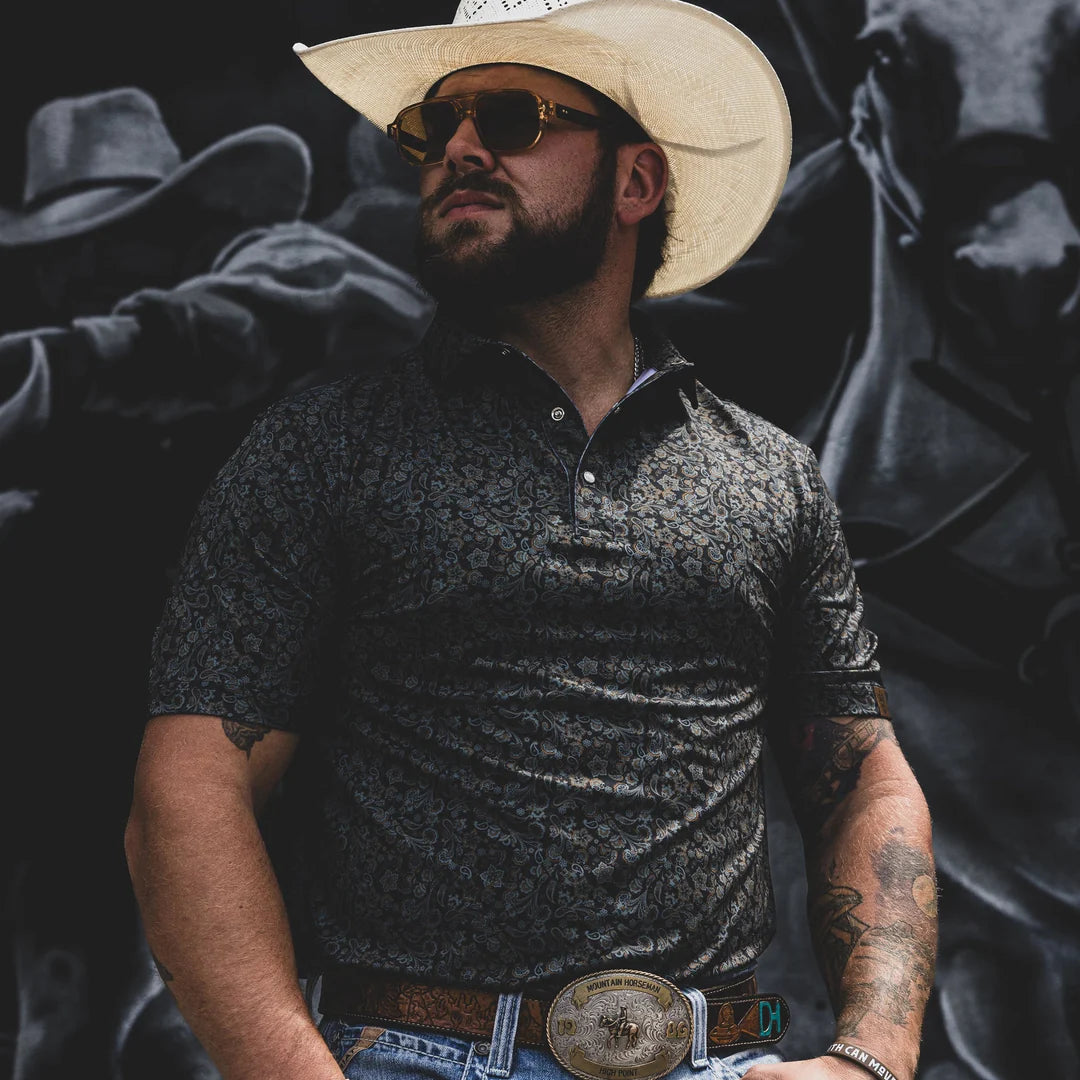
Tough and timeless, this polo is built for the long ride. Featuring a crisp, non-collapsing collar and a rugged, stretchy fabric, it's the perfect shirt for any cowboy's wardrobe.
Children who are too small to ride their horses alone are pulled alongside other family members with a lead rope. From elders to infants, everyone participates in the parade. Entire families sit atop decorated floats throwing candy, fans, and cold bottles of water to the crowd.
I love the sound of the elk teeth colliding against each another as the women go by and the rhythm of horse hooves as they hit the pavement. At the parade’s end, the participants are judged individually for their regalia, horses, and overall parade appearance.
Crow Fair bustles with activities, and there’s precious little time allotted between events — it’s almost impossible to get to them all. You have the parade, Indian horse relays, arrow throwing, dance specials, powwow, and music! It’s always fun to try to make it to Custer Battlefield Trading Post for lunch — the fry bread taco is amazing!
The arbor is at the center of Crow Fair. Encircling the big grassy field where the powwow takes place, the arbor is filled with Native American handcrafted items, food, blankets, and typical tourist essentials. I especially love the Native peddlers who bring authentic items for sale. You always want to have some cash on hand for something that strikes your eye and for the freshly squeezed strawberry lemonade — can’t forget that!
Everything is a circle in Crow culture. Circles represent life. At Crow Fair, you will start noticing the theme everywhere — in the beadwork design, the surface of a drum, the direction in which the parade flows, the way the inside tepees are arranged. The entire Crow Fair is a circle. It’s easy to get lost there. Every tepee seems to look the same, especially at night. But there are only four or five dirt paths that take you to the outer circle, where you can get your bearings and find your way.
When the Grand Entry begins, the drums shake your very soul. The vibration moves from the bottom of your feet to the middle of your chest. Drum groups are strategically placed between sections of the crowd-filled bleachers.
Crow Fair welcomes all tribes, and it makes for a magnificent display of tradition, culture, color, and coming together of all people. Dancers and drum groups are all rhythm, color, motion, and sound, adhering to strict rules for performance as they’re judged for prizes and money. The powwow action lasts long after the sun goes down.
Indian horse relays are a crowd favorite. It’s a high-intensity sport, displaying the incredible relationship between horse and rider. Bareback, no less!
My favorite part of Crow Fair, though, is wandering around the tepees and camps. (If you do this, be respectful and courteous, and don’t wander too close. Go gently with your camera, too — always ask permission.) You’ll see children playing, and bathing in the Little Bighorn River, cooling off from the summer sun. Elders sit in the shade of enormous cottonwood trees, closely watching the festivities. People on picnic benches share stories. Smoke rises over the lodge poles where families are gathering for dinner. It’s in that walking around that I most experience the rich life of the tribe.
This year marks the 99th Annual Crow Fair Celebration. It will be held August 16 – 21 in Crow Agency, Montana. Visit Crow Fair Events and 2017 Crow Fair Rodeo on Facebook.
Pinnacle of the Parks
Prior to its official inception in 1916, the National Park Service already had strong roots in the West with the original 10 parks dotting the map across Wyoming, Montana, Washington, Oregon, Colorado, South Dakota, and California, which alone now have nine parks. And even today, more than a century after President Woodrow Wilson signed the Organic Act, the West is still home to the majority of the 59 parks and even more national monuments.
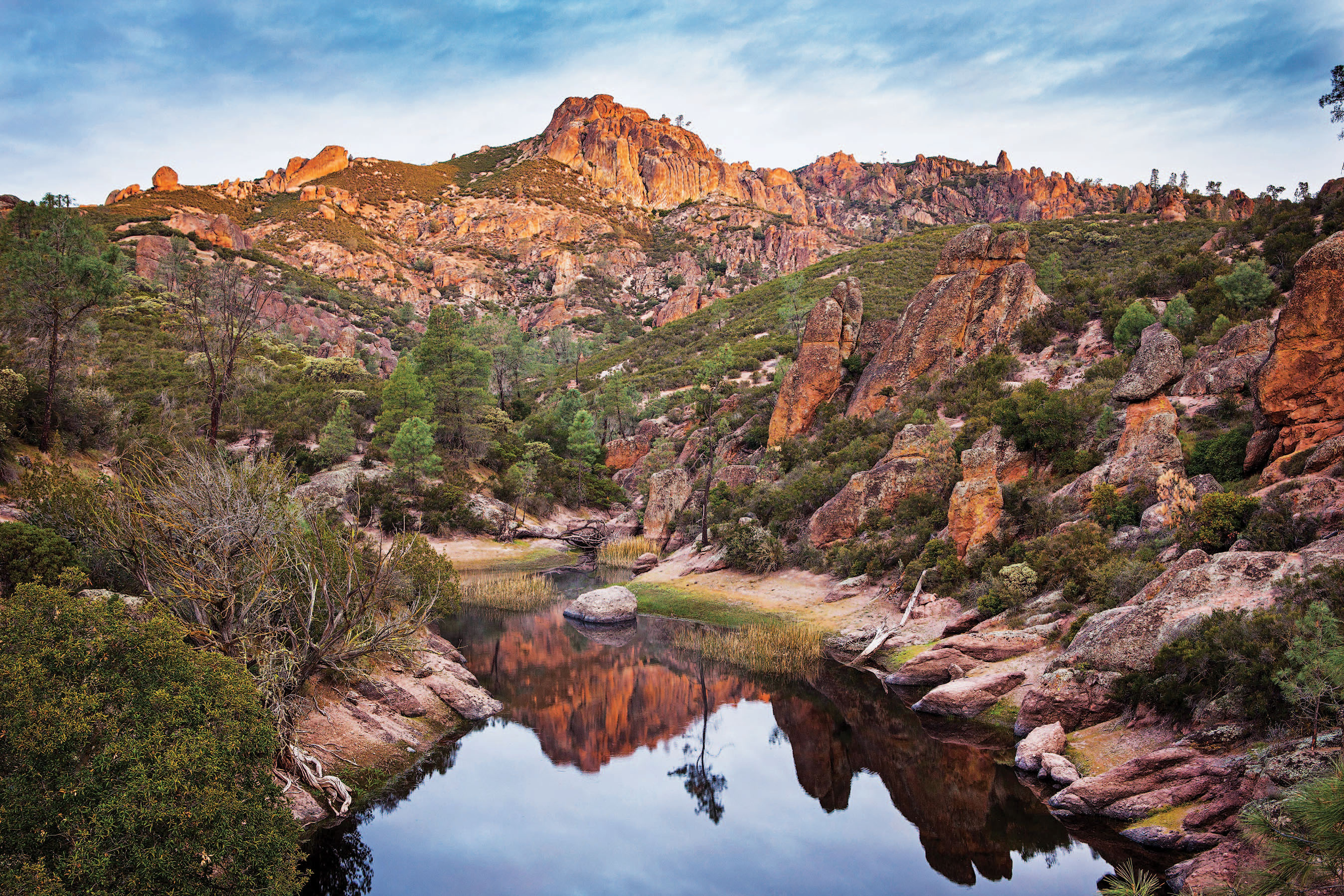
The youngest of the parks, established back in 2013 (it had been a designated national monument since 1908), continues the legacy that the founding fathers of the national parks envisioned for conserving and protecting America’s most sacred natural treasures. Pinnacles National Park in the coastal hills of California has deep gorges and caves fit for any adventure. The ancient volcanic rock creates a jagged landscape and hiking paths through forests and canyons. Between rock climbing, bird-watching, camping, and hiking, Pinnacles captivates visitors with its breathtaking landscapes and extensive opportunities to experience nature.
—Victoria Mechler
Learn more about the National Park Service on the official website. Read more about our favorite national parks and the NPS.
Opry on the Airwaves and Online
At nearly a century old, the Nashville AM radio station WSM 650 remains a relevant influencer in the country music world. That’s because it lifts up the genre’s rich and important traditions with every broadcast. A couple of months after its 1925 debut in Music City, the station began airing Grand Ole Opry broadcasts, in effect becoming a loudspeaker for country legends in the making. Tune in to WSM in Nashville or just about anywhere in the world (via online stream or app) and you’ll still hear live Opry broadcasts on Tuesday, Friday, and Saturday nights. There are also bluegrass and Americana shows, as well as programming blocks hosted by artist Tracy Lawrence and renowned DJs Eddie Stubbs and Bill Cody. Simply put, if the newfangled pop-country on your local station doesn’t please you, WSM’s more traditional and twangy sounds are but a click away. Its site has a deep archive of Opry broadcasts and other programs, as well.
— Hunter Hauk
Listen to WSM or get its app online now.