
John Wayne was — and remains — as much an icon of the historical West as any of the legendary figures that were actually there. He is still the most recognizable symbol of a mythical era, and the idealization of the American cowboy’s rugged individualism, resourcefulness, and heroism.
In this, the 110th anniversary year of his birth, we celebrate his legacy with a collection of 110 moments, memories, and milestones from an extraordinary life.
check out our premium collection
1. John Wayne’s great-grandfather Robert Morrison emigrated from Ireland to America in 1799, after his participation in the Free Irishman Movement prompted the British Crown to issue a warrant for his arrest.
The Midnight Troubadour
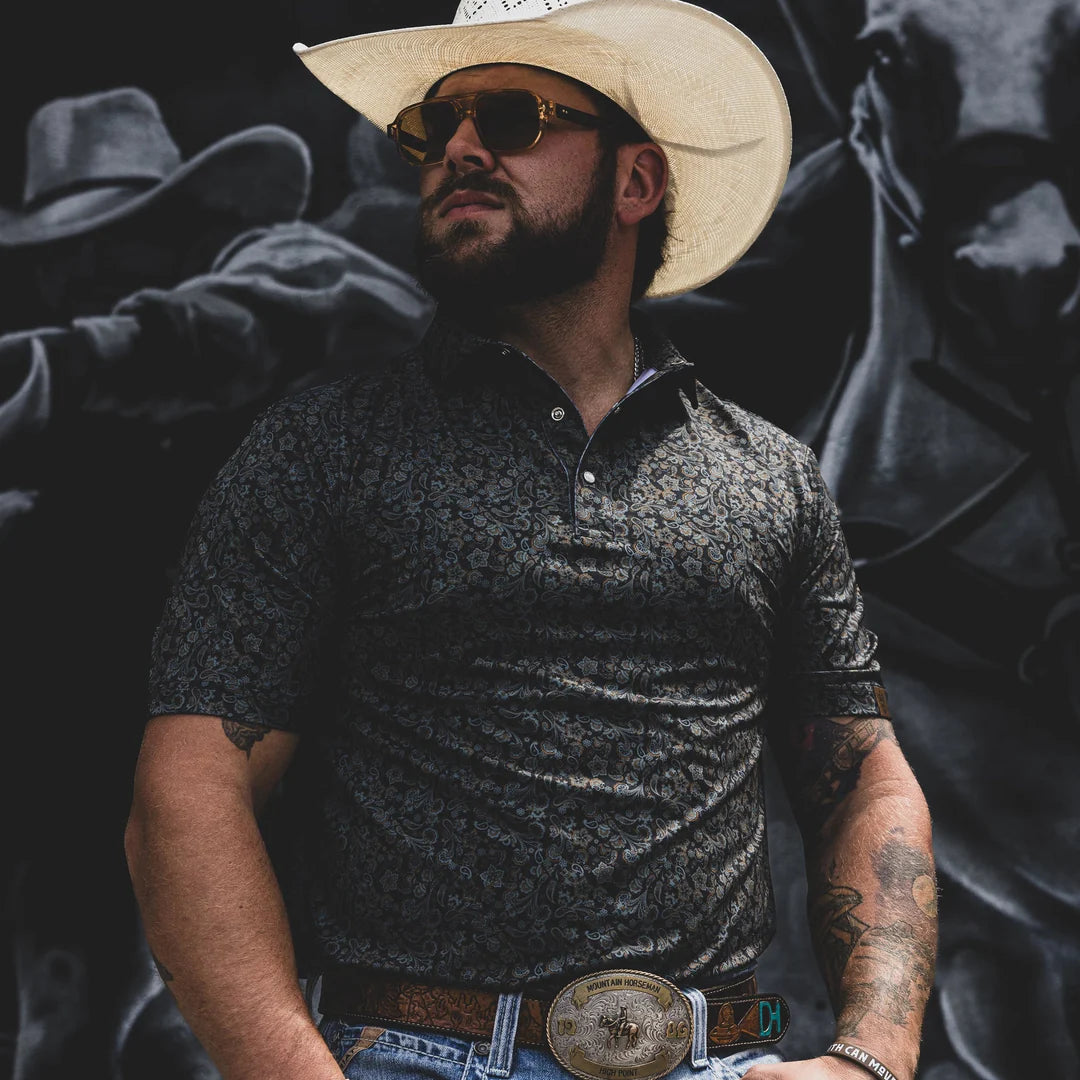
Tough and timeless, this polo is built for the long ride. Featuring a crisp, non-collapsing collar and a rugged, stretchy fabric, it's the perfect shirt for any cowboy's wardrobe.
2. President Jimmy Carter on John Wayne: “In an age of few heroes, he was the genuine article. But he was more than a hero. He was a symbol of so many of the qualities that made America great.”
3. While still in elementary school, he had a pet Airedale named Duke. Seeing the boy and his dog together, local firemen began referring to the boy as “Little Duke” and then just “Duke.” The nickname stuck.
4. An honors student and senior class president at Glendale High School, he performed a scene as Cardinal Wolsey from Henry VIII at the annual Southern California Shakespeare Contest.
5. He made his film debut in Brown of Harvard (1926) while still a member of the University of Southern California’s football team. As the stunt double for actor Francis X. Bushman, he is seen from the back only, running down a football field and being tackled from behind.
6. In the Lillian Gish film Annie Laurie (1927), Wayne wears a kilt as one of dozens of extras recruited as Scottish Highlanders.
7. The first time he received an on-screen credit was for the 1929 film Words and Music. He was billed not as Marion Morrison, his given name, but as Duke Morrison.
8. He spoke his first words on-screen as a naval cadet in John Ford’s 1929 film about the Army-Navy football rivalry, Salute.
9. Did John Wayne ever meet Wyatt Earp? He once mentioned having done so while still working as a prop man for John Ford, who was an acquaintance of the legendary Tombstone marshal.
10. Wayne on how renowned stuntman Yakima Canutt influenced the way he spoke in films: “I noticed that the angrier he got, the lower his voice, the slower his tempo. I try to say my lines low and strong and slow, the way Yak did.”
11. Several of John Wayne’s early films are now considered lost. Among those for which no copy is known to exist are Speakeasy (1929), The Forward Pass (1929), and The Oregon Trail (1936).
12. John Wayne’s brief career as a singing cowboy known as “Singin’ Sandy” reportedly ended after a publicity tour stop, when his horse supposedly relieved himself just before Wayne started to sing. Wayne’s son Ethan heard it another way: All Duke’s singing on the film was dubbed. When fans asked him to sing on the tour, he was so embarrassed, he gave up singing.
13. During an early career stretch of forgettable film roles, a despondent Wayne met Will Rogers, who asked him what was wrong. “I’m making a terrible movie,” Wayne said. “But you’re working, aren’t you? Just keep it up,” Rogers replied. Wayne later called that “the best advice I ever got ... just keep working and learning, however bad the picture.”
14. He was a big man — 6-foot-4. He was also a big baby, weighing a whopping 13 pounds at birth (on May 26, 1907, in Winterset, Iowa).
15. John Wayne on his pre-stardom low-budget westerns: “My main duty was to ride, fight, keep my hat on, and at the end of shooting still have enough strength to kiss the girl and ride off on my horse — or kiss my horse and ride off on the girl.”
16. In 1933 alone, Wayne appeared in 12 films, from Telegraph Trail to Sagebrush Trail.
17. From 1938 to 1939, he made eight movies as Stony Brooke, a member of The Three Mesquiteers, a trio of heroic modern West drifters.
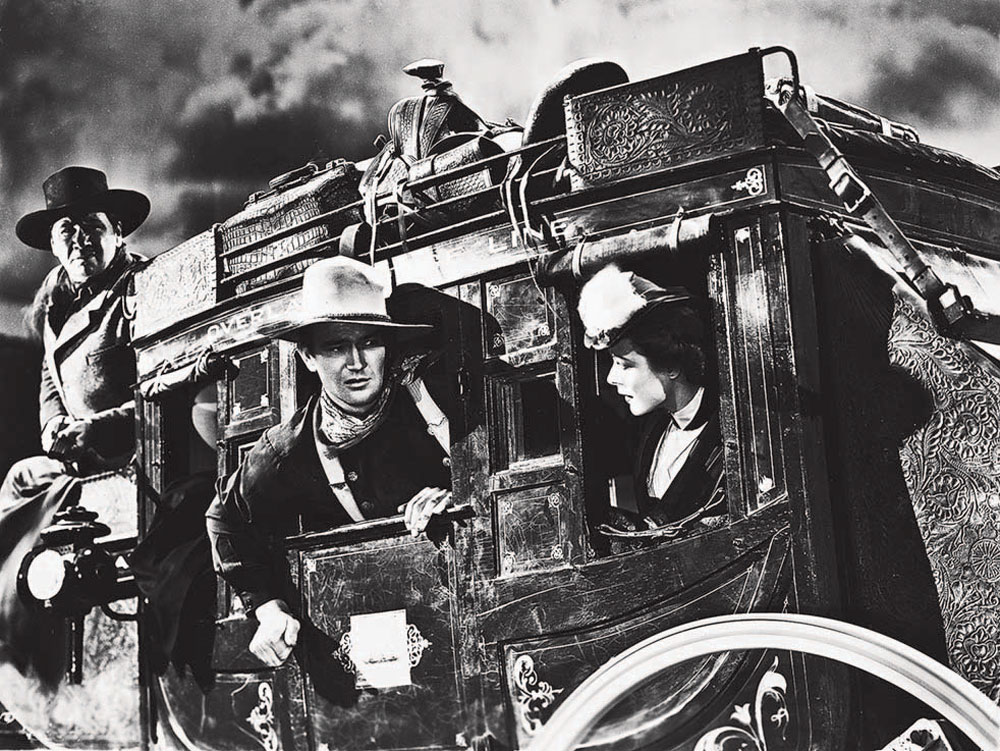
18. Whatever barbs critics could toss at John Wayne, no one could accuse him of being an overnight success. Stagecoach, featuring his breakthrough role as The Ringo Kid, was his 82nd film.
19. Wayne received a salary of $600 a week for Stagecoach. That same year, 1939, James Cagney was earning $12,500 a week.
20. John Ford on casting Wayne as The Ringo Kid: “He was the only person I could think of at the time who could personify great strength and determination without talking. That sounds easy, perhaps, but it’s not.”
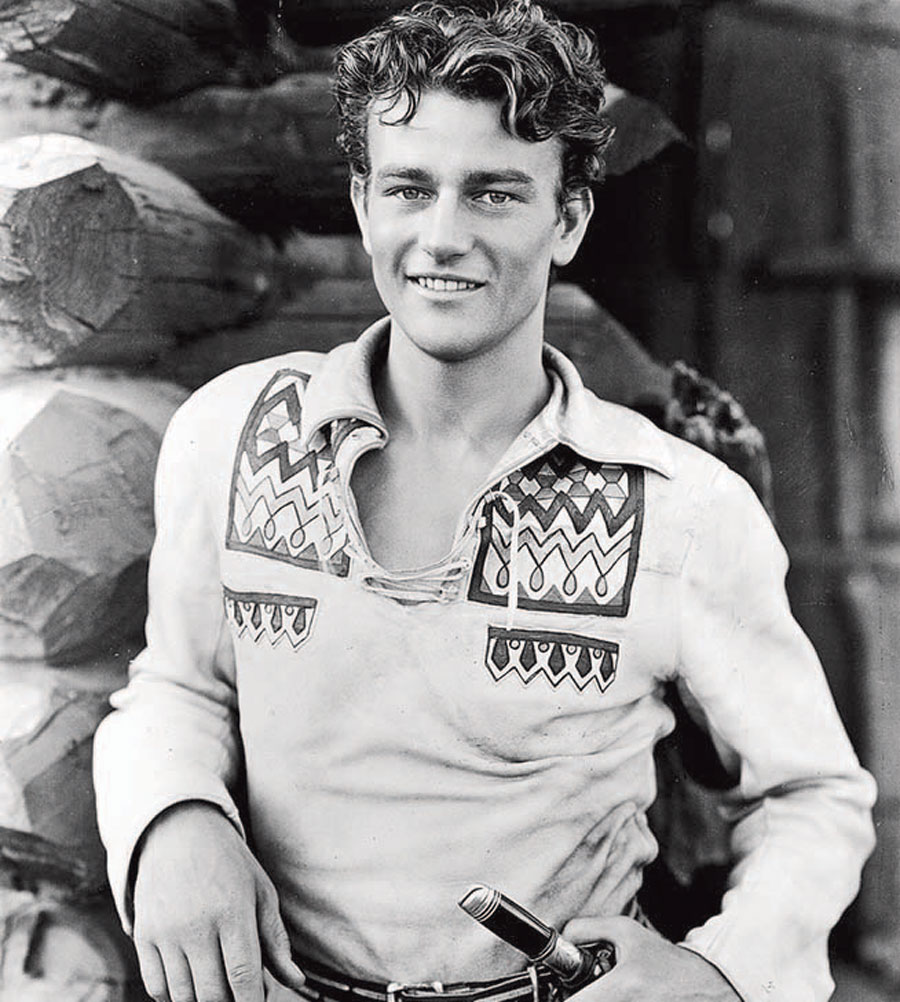
21. Why did The Big Trail (1930), released nine years before Stagecoach, not make John Wayne a star? The epic was shot in widescreen 70 mm but was released when theaters already converting from silent to sound films had no money to adapt to 70 mm technology. Audiences in all but a few theaters saw the movie with an extremely cropped 35 mm image that robbed The Big Trail of its spectacle.
22. How did “Duke Morrison” become John Wayne? Credit Fox studio head Winfield Sheehan, who wanted Duke to have a better name prior to The Big Trail ’s release. Sheehan was inspired by a book he had read on U.S. Revolutionary War Gen. “Mad Anthony” Wayne.
23. The 1932 film Two-Fisted Law marks the first of five times that the actor nicknamed Duke played a character named Duke.
24. The quotable John Wayne: “I never trust a man that doesn’t drink.”
25. Wayne requested 35 mm prints of many of his films after completing them. That may have saved Stagecoach after the original negatives were either lost or destroyed. He gave his copy to the American Film Institute.
26. Fort Apache screenwriter Frank Nugent on Duke’s imposing physical presence: “Having Wayne put his arm on your shoulder is like having somebody dump a telephone pole on you.”
27. Elizabeth Taylor on John Wayne: “He gave the whole world the image of what an American should be.”
 https://www.cowboysindians.com/2016/12/john-wayne-at-110/