
The two Victorian booklets lay side by side. Both covers were decorated by period rococo: encircling vines and foliage, swallows, vignettes of students in art class settings, and a very unhappy baby whose food was upended by a scampering rabbit. The booklets were collected by Henry Dawson, who ran a trading post at Pine Ridge, South Dakota, and were preserved by his descendants for well over a century.
In stark contrast to the booklets’ quaint Victorian covers were the contents drawn by two Oglala Sioux. It was these pictures that Dawson valued and preserved.
check out our premium collection
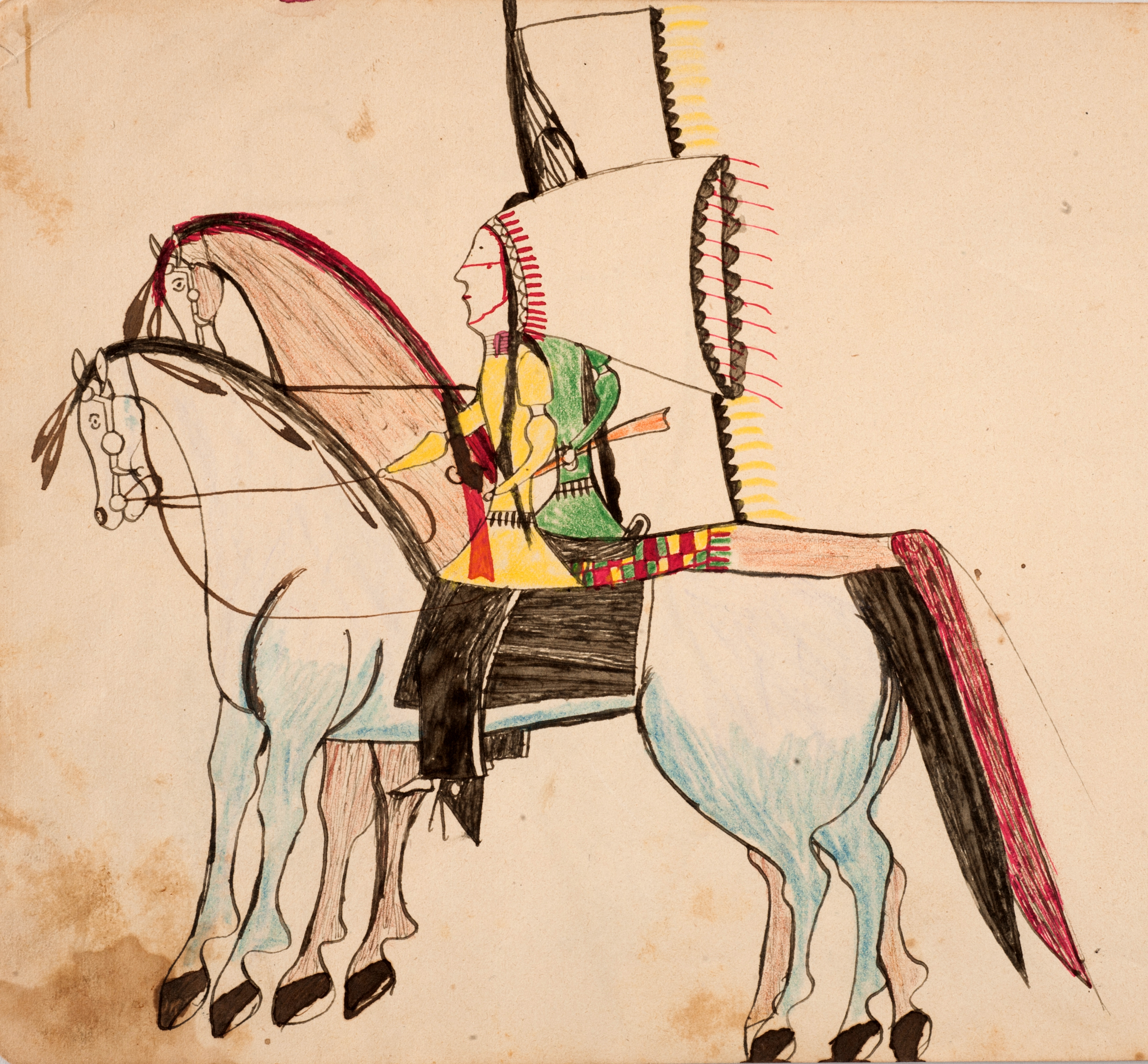
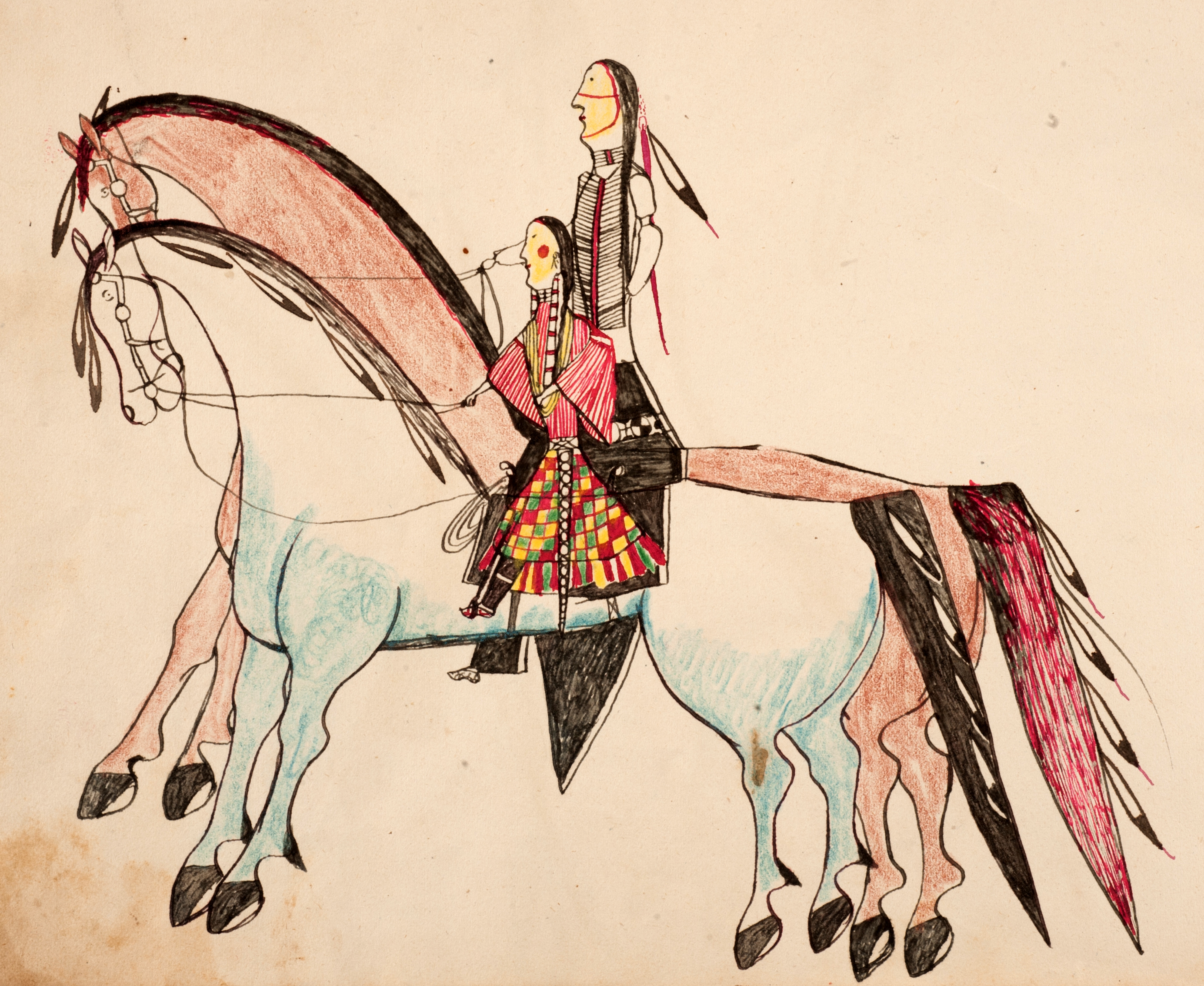
“The picture is the rope that ties memory solid to the stake of truth,” a Lakota elder once said, and in the ledger drawings of Oliver Good Shield and Henry Standing Soldier many memories were tied to much truth. The first booklet illustrated 11 warriors on horseback and one woman. The other captured a transitional change of an Indian adapting to a cowboy’s way of life in the Dakota Territory. Both artists could write but chose to express their thoughts in a traditional form of imagery. The reason these two men are remembered today is because of their ledger art.
The Midnight Troubadour
Tough and timeless, this polo is built for the long ride. Featuring a crisp, non-collapsing collar and a rugged, stretchy fabric, it's the perfect shirt for any cowboy's wardrobe.
Ledger Art as History
For centuries of life on the Great Plains, figures and symbols recorded on rock or hide fulfilled a need to communicate beyond words. It was only when paper became available after the Civil War in the form of business ledgers and notebooks that the Plains Indians sought this new technology as a practical and convenient medium for creating.
Ethnographic images recorded on paper using pencil, ink, crayons, and watercolors are called ledger art. Cultural and art historians initially denigrated the work because of the use of European materials, but the prejudice has lifted. Once examined as historical documents, ledger drawings, which flourished from around the 1860s to the 1920s, are now considered complex works of art that illustrate the world of the artist. They also reflect the final decades of nomadic life on the Plains.
Most of the earliest ledger art depicts tribal warfare or the hunt. Its purpose was to enforce the essence of survival: sustenance and courage. It was strict attention to detail and utmost integrity in what they drew that validated the honor of the warrior. Beyond the display of the horse and gun, there is little evidence of non-indigenous figures or their cultural material.
The theme changes by the 1870s. U.S. troops and advancing settlers became featured antagonists. Wagons, Western saddles, and military equipment taken in battle became prevalent in drawings. By the middle of the decade, portions of southern Plains tribes that had surrendered to the government switched emphasis from documenting their bravery to chronicling their lives as prisoners at Fort Sill, Oklahoma, and Fort Marion, Florida. Among their illustrations are train rides, group calisthenics in prison courtyards, sailing boats, and shark fishing from shore.
The Pine Ridge-Henry Dawson Connection
Chief Red Cloud and other seasoned warriors understood early the logistical advantage of the U.S. military and turned “friendly,” a term coined by U.S. forces. In 1888 Red Cloud led his followers to the relative safety of Pine Ridge on the forks of the White River in South Dakota.
Henry “Hal” Americus Dawson arrived in Pine Ridge in 1885. By 1890, the year of the Wounded Knee massacre, Dawson had received his license to operate a trading post. He learned the language and customs of the Oglala, who named him “Pasu Hanska,” or Long Nose. Among his good friends were the moderate leaders American Horse and Young Man Afraid of His Horses.
Pine Ridge was toxic with despair. With the buffalo gone and game scarce, harsh conditions of the previous year had ushered in disease and starvation. The government had turned tribal members against each other, scamming more land for settlers. In the midst of bureaucratic insanity, the Bureau of Indian Affairs cut the monthly allotment of food.
The Lakota found hope in the Ghost Dance, a ritual that, properly exercised, would bring back the buffalo and life as they once knew it. Magical shirts promised protection from firearms. Though the dance and chants were harmless, the concept of bulletproof garments provoked panic that the Lakota intended to fight.
Fear spread across Dakota Territory. By December of 1890, it would precipitate the death of Chief Sitting Bull and set up the final confrontation of Big Foot’s Miniconjou at Wounded Knee Creek, not far from the Pine Ridge Agency.
The prior arrival of U.S. troops at the Pine Ridge Agency had sent local Ghost Dancers and frightened families to a distant part of the reservation called the Stronghold. Forced to surrender after the massacre at Wounded Knee, their walk back became a trail of woe. Reluctant youth, enraged with frustration, harangued their elders for cowardice and shamed them by discharging firearms close to their heads.
In truth, the role of the warrior as tribal provider and protector had come to an end.
The Drawings of Oliver Good Shield
Oliver Newton, whose tribal name was Oliver Good Shield, left the Pine Ridge Reservation in 1887 to attend Carlisle Indian School in Pennsylvania. His father, Cross Dog, was born about 1829 and married Jenny, a Lakota woman in 1856. Their relationship lasted 44 years. Good Shield was born in 1868 and both parents were still alive when their son left for Carlisle at age 19.
Good Shield was a member of the Spleen Band led by White Bird, born about 1841. By 1873 White Bird had joined the politically astute Chief Red Cloud near Fort Robinson. Red Cloud and most of his Oglala followers sat out the Sioux War of 1876 against U.S. forces.
As the events at Wounded Knee unfolded, Good Shield was with the J. Balderston family in Lahaska, Pennsylvania, learning to farm. They were one of five families he would intern with during his sojourn back East. Despite the upheaval at Pine Ridge, Oliver Good Shield stayed his course and returned to the reservation in 1893.
Ledger drawings of the Lakota and their Northern Cheyenne allies show ample evidence of ongoing tribal warfare continuing well into the 1880s. Factions of both tribes had taken the U.S. military head-on. Crow and Pawnee, longtime enemies of the Sioux and Cheyenne, joined government forces against them, adding fuel to the fire.
Nor was it one-sided. Cheyenne Dog Soldiers and their Lakota counterparts, the “Miwa’tani,” were highly disciplined and extremely brave military societies who sought their opponents. Together in small groups or apart they perpetrated an unknown number of raids and skirmishes against tribal enemies during this period.
Good Shield wrote clearly in pencil on the front of his booklet: “A PICTURE OF WARRIORS.” His drawings display items associated with the elite Miwa’tani. In one, a figure wears a split animal skin or sash that obligated the owner to stand fast against his opponents as his comrades retreated. A red wool sash displayed by two other figures denotes a similar sacrifice.
Banner staffs lined with eagle feathers, crooked staffs, and coup sticks carried by the various figures are all symbols of bravery. A coup stick offered a path to glory as the owner would dash forward to touch his enemy and withdraw while under fire.
Warrior artists frequently, but not always, represented themselves in their drawings. Good Shield displayed only one horseman with an elaborate shield, as his name implies. If it is Good Shield, his detailed treatment of the human face places him in several images. The artist was precise: cartridge belts have bullets, one horse shows tiny splits on the tips of his ears, a Cheyenne symbol for a racehorse, “drag cords” are attached to horses and gave a dismounted rider a chance to catch his animal. Good Shield drew a variety of saddles. The woman’s saddle is traditional. A military McClellan and a stock saddle might be spoils of
Source: https://www.cowboysindians.com/2017/07/drawing-history/