
The Players Championship is the PGA Tour’s signature event – a flashy, easy-to-promote tournament played in the Tour’s front garden, over a track that literally has “stadium” in the name. The field strength is unimpeachable, the event usually crowns a big-name champion, and Pete Dye’s hazard-strewn former swamp can often be counted on to perform closer to a baked-out mid-August links course. See last year’s Saturday carnage or the travails of Zac Blair on the trampoline-like 17th this year for proof:
We see big numbers every year at 17.
????#PGATOUR360 ◀️SWIPE▶️ pic.twitter.com/waWzUlqtiu
— PGA TOUR (@PGATOUR) May 12, 2017
So the Players is a big deal, and with good reason. But despite all the glitz, the event falls slightly short in one category: history. The tournament started in 1974, so yes, it’s been around for more than 40 years. The Stadium Course at Sawgrass has hosted since ’82, back when the original Big Three of Palmer, Nicklaus, and Player could still be seen striding the fairways. Still, it’s not a blue-blood tournament on the circuit. I equate The Players roughly to Chelsea Football Club – an English soccer team that toiled in relative mediocrity for most of its history, then swiftly rose to become a freespending world power in the past two decades after being purchased by Russian oligarch Roman Abramovich. Both are high-powered, Hollywood-caliber names, but poke around a bit in their past and the foundations look a touch crumbly.
The Midnight Troubadour
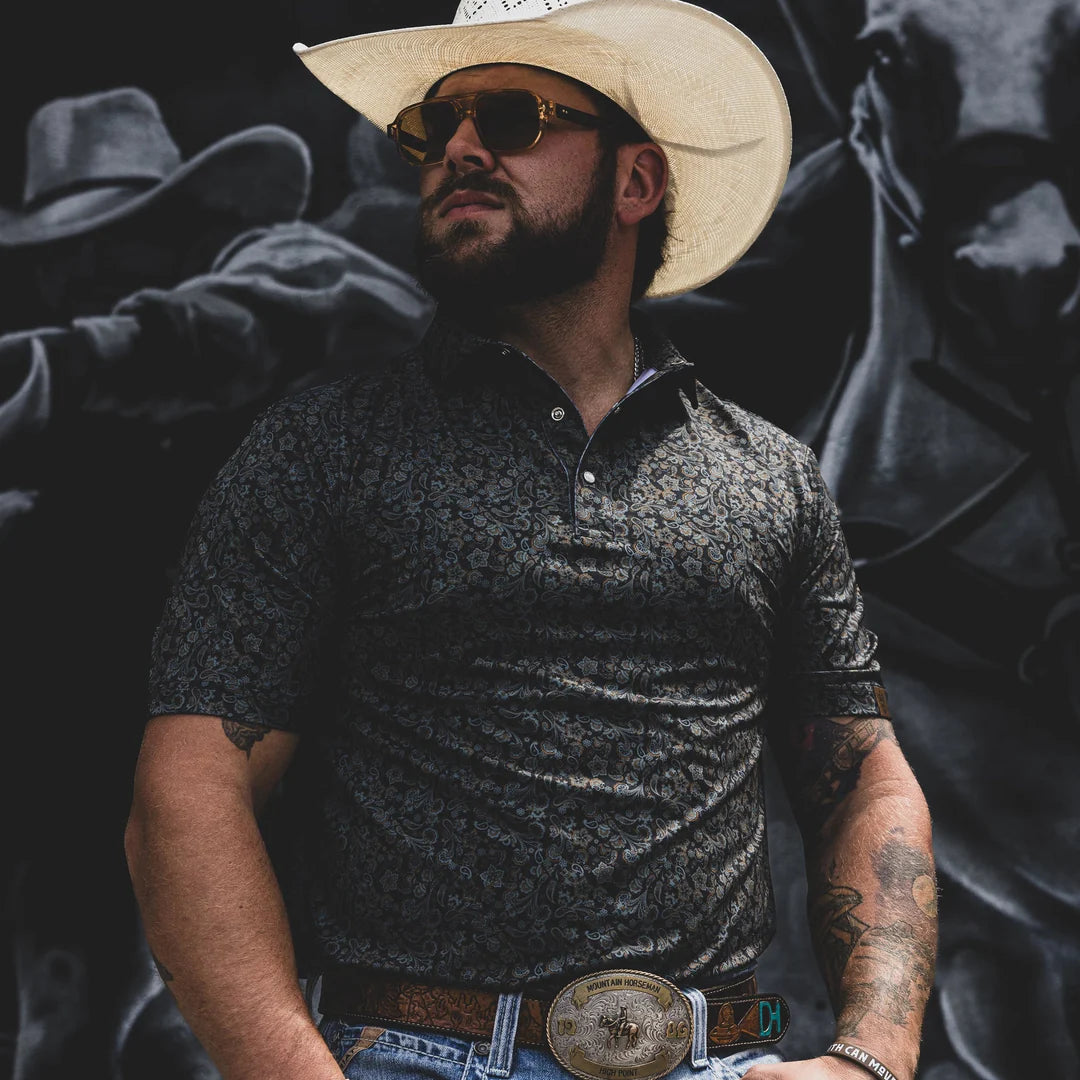
Tough and timeless, this polo is built for the long ride. Featuring a crisp, non-collapsing collar and a rugged, stretchy fabric, it's the perfect shirt for any cowboy's wardrobe.
That’s where Colonial comes in.
Hogan tees off on the 17th hole of the 1959 Monday playoff – his last win here.
Photo: Fort Worth Star Telegram
Tournament Roots
The PGA Tour has been returning to the banks of the Trinity River in Fort Worth, Texas for 71 years. Currently called the Dean & Deluca Invitational (shoutout Bob Ducca), the Tour’s event at Colonial Country Club is the longest-running non-major event to be held at the same site.
Colonial was designed in part by Perry Maxwell, a highly prolific architect whose crown jewel was Tulsa’s Southern Hills, and who also made renovations to Augusta, Pine Valley, and National Golf Links, among others. The course opened in 1936 and played to a then-gargantuan length of 7,035 yards (par 70) when it hosted the 1941 U.S. Open. Five years later, Colonial hosted its inaugural PGA Tour invitational, won by the hometown boy Ben Hogan. Since then, the event has become one of the most iconic on Tour for several reasons.
First, obviously, the years of tradition. Hogan won five times here, and called the club home after he retired. The tournament has been played here every year since its inception aside from 1949 (course flooded) and 1975 (when Colonial hosted the aforementioned Players Championship). Champions receive a custom Royal Tartan plaid jacket, first awarded in 1952. Winners include Snead, Sanders, Palmer, Casper, Weiskopf, Trevino, Crenshaw, and we’re not even into the ’80s yet. Big guns win here.
Second, the track. Colonial isn’t a tricked-up Mickey Mouse affair that demands blind shots and rewards lucky bounces. It’s long, tight, and demanding. Precision is rewarded, and wayward efforts are punished. Ben Hogan once mused that “a straight ball will get you in more trouble at Colonial than at any course I know.” The course’s dog-legged fairways require shots worked in both directions, and recovery efforts often need to negotiate thick, snarling tree limbs. In short, it’s not easy.
Colonial’s short, but penal, 17th
Photo: GolfAdvisor
Third, the event’s unique stance on who gets to play. It’s one of five invitational tournaments on the tour (Arnold Palmer, RBC Heritage, Memorial, and Quicken Loans being the others), meaning the event gets some leeway in field selection. Along with the regular assortment of touring professionals, the 125-man field is chosen by a variety of interesting methods. Some of the better ones:
Colonial winners prior to 2000 and in the last five years
Colonial Winners in top 150 of prior year money list
I like this because it eliminates random recent tournament winners who aren’t consistently good.
Playing members on the last named U.S. Ryder Cup team
‘Merica
Current PGA Tour members who were playing members on the last named European Ryder Cup team, U.S. Presidents Cup team, and International President’s Cup team
Fine, not just ‘Merica
Two players to be selected by the current and former champions of the Colonial tournament (Champions Choices)
THIS is an idea I can get behind. Almost like a European Tour exhibition mixed with a video game “choose your character” screen. We need to blow this out into a hybrid of Selection Sunday and a Bachelor rose ceremony, swapping out the champagne for whiskey and the roses for tee gifts. Dave Stockton is the only player to win the event after getting in as a Champions Choice, in 1967.
Top 15 finishers and ties from previous year’s Colonial Tournament
If The Players had done this, #FreeDuke wouldn’t be necessary.
12 sponsors exemptions — 2 from among graduates of Web.com Tour finals, 6 members not otherwise exempt, and 4 unrestricted
*Googles “Anthony Kim + Dallas” *
Members in the top 125 non-member category whose non-WGC points for the previous season equal or exceed the points earned by the player finishing in 80th position on the prior year FedEx Cup points list
Wut.
Past Winners
It’s an absolute murderer’s row. Everyone who’s anyone has won this tournament. In addition to those mentioned before, Zoeller, Nicklaus, Wadkins, Lehman, Watson, Mickelson, Garcia, Perry, ZJ, Scott, and Spieth have added their names to the Wall of Champions.
Jordan Spieth admires his entry on Colonial’s Wall of Champions
Photo: Jordan Spieth Golf
Notably absent: Tiger Woods, who only played the event in 1997; and Dustin Johnson, winner of a PGA Tour event each of the past 10 years.
Notable Moments and Finishes
First of all, let’s take a look at the winning scores from the first ten years of the tournament and the last ten.
Back in the day…
And today
These guys are good (TM)
2016
Jordan Spieth broke out the scuba gear and dropped down into the bathypelagic zone, going 67-66-65-65 for a 17-under finish and a three-shot victory over Harris English. Spieth is a Dallas native, and got revenge for his 2015 finish where he lost by 1 to Chris Kirk.
2014
Adam Scott beat Jason Dufner in what was surely the lowest-key playoff in PGA Tour history. Fun fact: Scott was # 1 in the world at this time, marking the only time in tournament history that a World No. 1 has won the event.
2013
Boo Weekley beat Matt Kuchar by a shot in what was surely the lowest-key regulation finish in PGA Tour history.
2010
Zach Johnson plumbed the depths of the Mariana Trench with a tournament-record 259. His 21-under included back-to-back 64s; on Sunday he was one of only two players to card a 6-under round. The Iowan most likely thinks of Forth Worth as “Fort Net Worth”: ZJ is the career ear
Source: https://nolayingup.com/blog/hogans-alley-colonials-tradition-rich-history