
Prolific artist John Mix Stanley traveled many thousands of miles through the western territories painting portraits of American Indians. He made the rounds with his artwork in popular traveling exhibitions attended by as many as 1,000 people a day. And his North American Indian Gallery hung prestigiously in the Smithsonian Institution. In his day, he was viewed as the premier painter of Native Americans. But today his name is relatively unknown, in part because the majority of his works were destroyed.
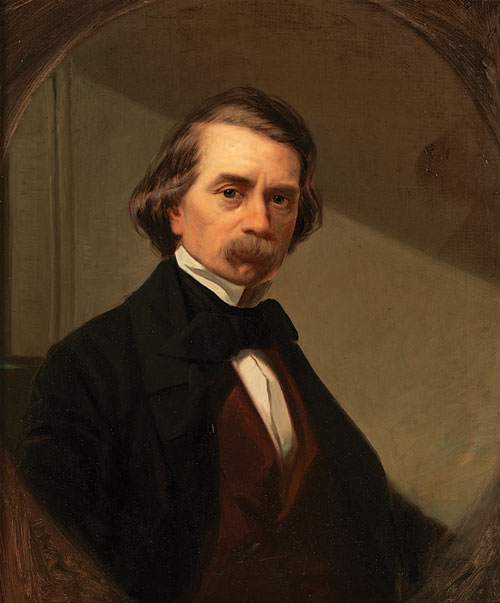
After devoting his life to authentically presenting Native Americans in fine art, Stanley lost most of his paintings in a catastrophic fire that nearly leveled the Smithsonian. The New York Times published a story about the tragedy, datelined Washington, Tuesday, January 24, 1865: “This afternoon, about 3 o’clock, a fire broke out in the Smithsonian Institute building, in the loft above the picture-gallery, between the ceiling and the roof, caused, it is believed, by a defective flue. The ceiling soon fell in, and in a few moments the gallery was one sheet of flame. ... The windows of the picture-gallery soon burst out, disclosing only the shell of the room. There were some two hundred of STANLEY’s pictures here. He had negotiated for their sale to the Michigan University. Only five or six of them were saved. The loss is very serious. ...”
check out our premium collection
Workmen had been tasked with rearranging paintings in the Indian Gallery, which was hung floor to ceiling with original portraits of Native Americans primarily by Stanley and Charles Bird King. It had been a bitterly cold winter, and two workers had temporarily installed a stove to keep warm, running a stovepipe to what they mistakenly thought was an exhaust flue. A few days later, smoldering behind the wall caused the great sandstone building to go up in flames. Even as a portion of the ceiling was caving in, employees tried to remove paintings from the walls. Although a half-dozen or so were saved, more than 200 were unrecoverable — lost was “the most valuable collection in existence of illustrations of the features, costumes and habits” of Native Americans, wrote the Smithsonian’s first secretary, Joseph Henry.
The Midnight Troubadour
Tough and timeless, this polo is built for the long ride. Featuring a crisp, non-collapsing collar and a rugged, stretchy fabric, it's the perfect shirt for any cowboy's wardrobe.
“The Apparatus room, the picture gallery, the Regents room & lecture room were destroyed,” Henry’s daughter recorded in her journal. “I went this morning to visit the scene of destruction. All Smithson’s personal effects; all Dr. Hare’s philosophical apparatus, the Stanley Indian Gallery of portraits have all perished. We entered the Apparatus room first. The dismantled walls & towers rose high above us reminding us of the ruins of some English Abbey. ... We picked our way over the cinders & burnt bricks through the lecture room to the Picture Gallery. The remains of the dying gladiator lay scattered about — we picked up a few pieces but they crumbled in our fingers. ...”
So it was with a certain literal flair that 150 years later a press release headlined “Rediscovered: An Artist’s Legacy Rises From the Ashes” announced the first major exhibition comprehensively covering Stanley’s work. Organized by the Buffalo Bill Center of the West, Painted Journeys: The Art of John Mix Stanley finally gives the artist his due. Co-curated by Peter H. Hassrick, director emeritus and senior scholar at the center and director emeritus of the Petrie Institute of Western American Art at Denver Art Museum, and Mindy N. Besaw, curator at the Crystal Bridges Museum of American Art in Bentonville, Arkansas, the groundbreaking exhibition featuring 60 key works is on view at the Tacoma Art Museum in Tacoma, Washington, January 30 – May 1. Cowboys & Indians talked with Hassrick about the exhibit, the painter’s heartbreaking loss, and his rediscovered legacy.
Cowboys & Indians: Put Stanley in his historical Western context for us.
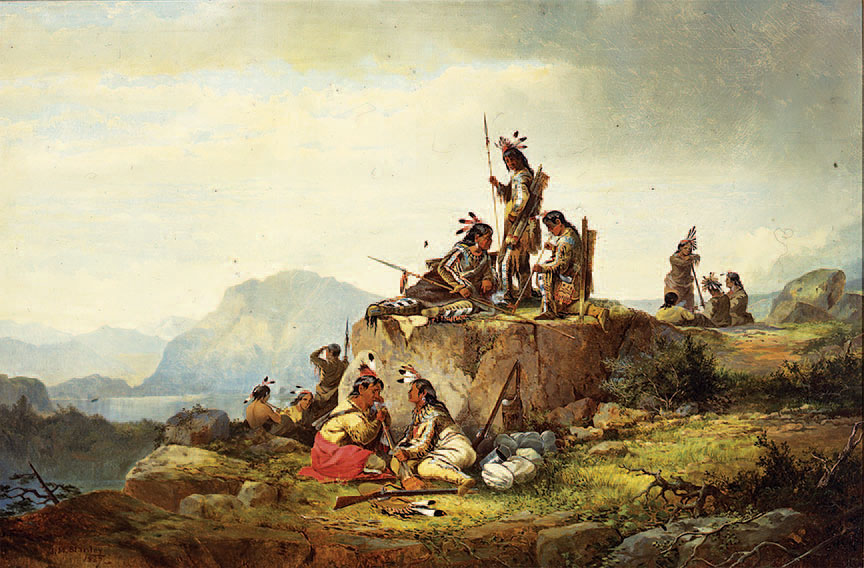
Peter H. Hassrick: Stanley was born in 1814, grew up on the western boundary of Troy, New York, and began his career as an itinerant portrait painter in Detroit. He first came West in 1842, traveling through Indian Territory and the Far West, which gave him the impetus to build and create an Indian Gallery of portraits and scenes of Native people and their life ways in order to preserve and enrich their legacy. Over the course of 15 years, Stanley found many opportunities to head West. He traveled the Santa Fe Trail and joined up with Gen. Stephen Kearny’s Army of the West’s march toward California and served as the official artist. Stanley wandered through Minnesota and Washington territories as a member of Isaac Stevens’ Pacific Railroad survey expedition. He even sailed to Hawaii, where he had the opportunity to paint the portraits of the then-king and queen. Remember, his travels in the West came during contentious antebellum times of competing regional interests. There was a burgeoning national desire for westward expansion, and he had to navigate the many sectional divides and attitudes.
C&I: Stanley’s described as an artist-adventurer — what did that hyphenation mean in his era?
Hassrick: He probably traveled more in the West than any artist of his day. There was a certain sense of being especially American by being an adventurer — venturing out into the unknown parts of America. Stanley was revered for that quest for adventure as well as his capabilities in the studio. He was a restless man full of wanderlust who did not see himself sitting in the studio painting fancy people. The Indian became that invitation to adventure. Two years in a row he went into Indian Territory, to the Brazos River in Texas and to Louisiana. He gets back in the saddle and goes along the Santa Fe Trail. Conscripted into the Kearny expedition, he gets all the way to San Francisco as a member of that expedition. After arriving there, he starts off on his own — 300 miles up to the Columbia River and back down to San Francisco. Then he travels off to Hawaii for a year and back home in 1850. On his return, he paints his Indian Gallery and takes it around the country, ending up in 1852 in D.C., where he’s turned down by Congress when they decline to purchase his work. The very next day he’s on a survey for the railroad. He was on the farthest north expedition with Isaac Stevens, the new governor of Washington Territory, as the official artist. He came back, got married, and never traveled again. That’s a lot of mileage. Mind you, this was all before there were trains in the West — all this travel was by horseback.
C&I: Why didn’t Congress buy his gallery?
Hassrick: He tried three times to get his Indian Gallery purchased. But purchasing it would have required Congressional appropriations, and that wasn’t going to happen, mostly because of the South and earlier Indian removal. The Jackson administration had cleared the Indians out and moved them forcibly to present-day Oklahoma. Having done that and taken Indian lands in order to expand the slave culture and cotton empire, they did not want the Indians to be particularly aggrandized. If the nation purchased the paintings and celebrated this Native culture, Southerners were afraid there might be some recrimination coming back on slavery and the decision to remove the Indians from their indigenous lands. The vote whether or not to purchase Stanley’s Indian Gallery came down to Jefferson Davis, and he voted no. It’s a powerful story of divisions and sectional divide, based on trying to salve the guilty conscience of the Jackson administration for the removal of the Indians from their homelands in the South.
C&I: Why isn’t he known as well as, say, George Catlin?
Hassrick: I think it’s a combination of the fire and the fact that before now there’s been no great exhibition of Stanley’s work. Both of Catlin’s maj
Source: https://www.cowboysindians.com/2016/01/the-lost-art-of-john-mix-stanley/