
Pork braised in its own fat, grasshoppers, Pacific bluefin tuna, scrambled eggs, goat cheese. Anything can be wrapped in a tortilla of corn or flour and be christened a taco — as long as there is a tortilla involved. Never mind that some chefs have taken liberties with the taco’s foundation, substituting naan or seaweed or gossamer slices of yucca. As far as I’m concerned, those aren’t tacos.
But when I look at an Indian taco, made by topping platter-sized Indian fry bread with classic Southwestern ingredients — seasoned ground beef, pinto beans, cheddar cheese, iceberg lettuce, and chopped tomatoes — I see a taco. That’s because fry bread is essentially a flour tortilla with the addition of baking powder, deep-fried in oil until it becomes fluffy and bubbly with a golden brown exterior.
check out our premium collection
In Planet Taco: A Global History of Mexican Food, author Jeffrey M. Pilcher notes that evidence of corn tortillas and maize in the American Southwest goes back as far as the 1300s. Edward S. Curtis, the great visual chronicler of Indian tribes in the early 20th century, snapped photographs of Hopi women grinding maize on flat stone cookware, akin to the traditional Mexican metate, and preparing it into wafer-thin, tortilla-like blue corn piki bread, just as it had been done for centuries.
The Midnight Troubadour
Tough and timeless, this polo is built for the long ride. Featuring a crisp, non-collapsing collar and a rugged, stretchy fabric, it's the perfect shirt for any cowboy's wardrobe.
Then tragedy struck, changing a nation and changing a food. Or so one theory goes.
Fry Bread Fundamentals
What we know as fry bread is commonly believed to have been born on the Long Walk, the forced march led by Col. Christopher “Kit” Carson and the U.S. Cavalry in 1864 that relocated thousands of Navajos to Bosque Redondo in New Mexico. Along the way, displaced American Indians were forced to subsist on the limited U.S. government rations that were alloted them. Processed flour, salt, and sugar were combined and fried in lard to make a kind of bread that would become part of Native food culture for years to come.
But Holt Hamilton — the independent writer and filmmaker behind More Than Frybread, a 2012 mockumentary about an Arizona tribal cook-off — questions this accepted origin story.
“A lot of stories talk about it being introduced by the military, which may be true in some cases, but I don’t believe this story across the many reservations we’ve visited,” Hamilton says, referring to his travels across the United States and Canada for screenings of his comedy. “I’ve talked with people from Alaska who say it came from Russia with the early traders and was traditionally cooked in seal oil or such.”
It’s plausible that fry bread’s invention occurred concurrently in disparate locations, from Alaska to the Four Corners, as Native communities encountered these unfamiliar ingredients for the first time, brought by the American military and Russian traders, as well as European settlers. In Canada and points north, fry bread takes the name bannock, based on the Celtic word for an unleavened barley or oat cake that originated in Scotland and was brought by traders across the Atlantic. Indigenous North Americans, like the Chippewa, often added dried fruit or spices to the imported flour, then fried the dough in a small amount of oil over a campfire.
But even for the Navajo, Hamilton does not consider fry bread a spontaneous creation born from limited resources — that would be too tidy. Instead, he sees it as an evolution of an ancient tradition triggered by grim circumstance.
“I am starting to believe that with the Navajo it was something that transitioned from other tortilla-type breads that were learned from farther south,” he says. “Then, when the cavalry came in, ingredients like less-healthy flour were substituted [for the traditional corn masa] out of necessity and survival mode.”
His theory is reasonable, especially when you note that flour tortillas are typical of the U.S.-Mexican border region and the northern states of Mexico, including Sonora and Sinaloa. They’re a consequence of Spanish conquest replacing corn with European white wheat flour introduced during the colonial period of New Spain. Which means that Native American tribes in the area would have been aware of flour as an ingredient in cooking long before Kit Carson.
Plains Indians, such as the Lakota Sioux, actually ground timpsula (also known as the prairie turnip) into flour and fried the dough they made with it. Lewis and Clark witnessed Indians cooking with the tuber as early as 1805 during their expedition.
But even if fry bread wasn’t simply a product of the Long Walk and internment, the revised history doesn’t detract from the significance of the food’s back story. The elements of bread-making were already established when Carson rounded up the Navajo and tore them from their land. The captives simply utilized the new provisions of lard, sugar, and flour in a familiar way. As Pilcher, an expert in the subject of tacos and Mexican food and a professor of history at the University of Minnesota, explains, “People start innovating with ingredients when they have a lot of it around. In this case, government commodity programs may be part of the story.” They did what they could with what they had and, in turn, created something so powerful it nourished their bodies and their identities.
The Indian Taco Trail
In the 20th century, at fairs and pan-tribal celebrations — or as The Route 66 Cookbook claims, originally at the Ranch Kitchen in Gallup, New Mexico — fry bread mingled with Southwestern and Spanish-Mexican influences and was transformed into a taco equally confectionary and savory. The doughy base evoked a flour tortilla crossed with a zeppole. When made by an experienced hand (like the art of tortilla-making, it can take decades to master fry bread), it creates a hearty yet tender base for a whole range of wet and weighty toppings.
One of the striking characteristics of the Indian taco is that it resembles the San Antonio-style puffy taco, made from deep-fried corn masa dough that is given its shell shape with the use of spatulas and dressed with fillings similar to those used in the preparation of a fry bread taco. The puffy taco — itself not immune to a debated origin in the San Antonio kitchen of Ray’s Drive Inn, Caro’s Restaurant in Rio Grande City, Texas, or the stove top of everyone’s grandmother — echoes Mexico’s tacos dorados, or fried tacos.
Whatever the Native dish’s provenance, these days powwows are inconceivable without a fry bread or Indian taco stand. There’s even a major cook-off: the National Indian Taco Championship in Pawhuska, Oklahoma. It’s the stuff of proud Native identity and pop culture. Fry bread figures into song, art, and film, like Sherman Alexie’s Smoke Signals, in which Thomas Builds-the-Fire (played by Evan Adams) dons a T-shirt bearing the words “Frybread Power.” In many ways, fry bread is at the foundation of modern pan-tribal identity just as corn (and the corn tortilla) forms the bedrock of Mexican culture.
Still, the specter of oppression continues to hover over the seemingly innocuous food. Fry bread carries at least 700 calories and 27 grams of fat per serving, according to the USDA. Researchers at the National Institute of Diabetes and Digestive and Kidney Diseases have been studying why Native Americans have incredibly high rates of Type 2 diabetes compared to the general population. It is believed that a cultural diet high in processed foods made from flour, sugar, and lard may be partly to blame. In response, some Native writers and artists have turned on fry bread. Creek/Euchee artist Steven Deo even went so far as to splash the phrase “Frybread Kills” across a 2004 public announcement-style poster as part of his Art of Indians series.
So the question has become, can fry bread be removed as a daily diet staple to improve health, yet maintain its cultural relevance and significance — and delectability — as an occasional indulgence? The answer appears to be yes when it comes to a new generation of innovative chefs and foodies, who are both elevating the Indian taco to a gourmet splurge and remaking it into a healthier alternative.
Taco Trendsetters
For home cooks, Hamilton and company are soliciting family recipes and creating a database on the World Wide Frybread Association website where, Hamilton says, “you can get a good piece of fry bread when you want to find one.” He’s advocating the use of healthier ingredients and decreased consumption, while continuing his grass roots effort to preserve this cultural signifier through the WWFA, which also hosts and encourages the establishment of fry bread cook-offs.
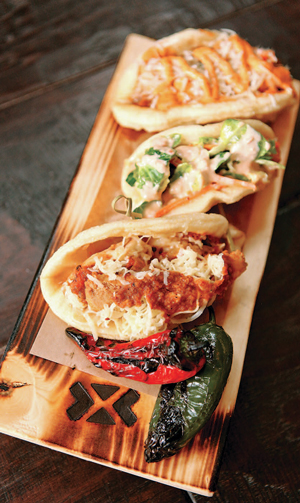
Meanw
Source: https://www.cowboysindians.com/2013/10/more-than-an-indian-taco-2/