
In the spring of 1888, when Charles Fletcher Lummis was scratching out a living as a freelance photojournalist in New Mexico, he wasn’t about to let a death threat keep him away from a scoop. The quirky 28-year-old Harvard dropout had gained national fame four years earlier when he had walked from Ohio to California to take a job at the fledgling Los Angeles Times, writing a witty regular newspaper column about his escapades along the way. But his fortunes had fallen since then. After nearly three years working at a breakneck pace as city editor in a boomtown, Lummis had suffered a stroke that had left him partially paralyzed, and he had retreated to the hinterlands of New Mexico to recuperate.
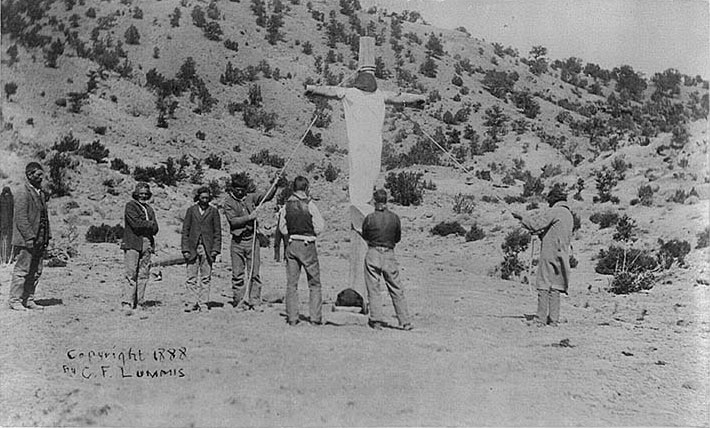
He was living in the hamlet of San Mateo, making ends meet by selling articles and photographs to publications nationwide about Pueblo dances, Navajo blankets and jewelry, Mexican American shepherds and their music, and other topics of interest in that exotic corner of the country. The most thrilling yet came his way in early March 1888 when he heard an eerie whistling sound wafting “like the wail of a tortured soul” out of a canyon near town. Asking around about it, Lummis learned it was a musical instrument used by members of a secretive Catholic cult called the Penitentes and that they were preparing to crucify one of their members on Good Friday.
check out our premium collection
“No photographer had ever caught the Penitentes with his sun-lasso, and I was assured of death in various unattractive forms at the first hint of an attempt,” he later recounted. The risk only added to the allure for Lummis. Just 5-foot-6-inches tall, he was muscular and pugnacious, and, as his readers had come to know during his “tramp across the continent,” he reveled in daunting challenges.
Determined to overcome the Penitentes’ resistance, Lummis met some of the group’s leaders, “overwhelmed them with cigars and other attentions,” and persuaded them to let him witness and photograph their Easter week rituals. The Penitente who had the honor of undergoing the crucifixion was tightly tied, not nailed, to the cross for several hours. But as Lummis told it, it was a scene that “might grace a niche in Dante’s ghastly gallery.” He sold stories about his daring run with the Penitentes, accompanied by his photographs, to newspapers from the Boston Transcript to the St. Louis Globe-Democrat to the Los Angeles Times, and eventually to one of the nation’s leading monthly magazines, The Cosmopolitan.
Later that year, on several occasions when Lummis was riding his horse on the range near San Mateo, he heard bullets whistle past. Some of the Penitentes had grumbled about his lurid depiction of their traditions, but he was sure they weren’t the ones out to get him. The common folk in San Mateo liked Lummis, a gregarious oddball who was learning Spanish quickly and hadn’t let his partial paralysis stop him from riding, roping, shooting rabbits, and rolling cigarettes with one hand. Besides, others around San Mateo had a more urgent interest in seeing him dead.
Lummis had turned his investigative energies in the latter half of 1888 toward a recent string of murders of nosy newcomers to that part of New Mexico, including a newspaper publisher and an election observer. He had built a case pinning blame for the killings on one of the most politically powerful clans in the county, then facing an unprecedented electoral challenge for a family-controlled seat in the territorial legislature. The Times ran Lummis’ story about the family’s long “reign of terror” on December 5, headlined “The Story of a Crime Thrillingly Told.” That report would surely raise the price that was already on his head, so the day after the story ran, Lummis left San Mateo and moved to Isleta, a Pueblo Indian village on the Rio Grande river south of Albuquerque, more than 100 miles away.
Apparently, that wasn’t far enough. Shortly after midnight on Valentine’s Day 1889, when Lummis took a break from writing and stepped outside his adobe dwelling to admire the moon, a would-be assassin hit him with a shotgun blast. Papers nationwide carried the news. Several reported that the plucky reporter had died. But the half dozen pellets that hit him narrowly missed his vital organs, and Lummis was back on his feet within days — “now loaded for bear,” as one paper put it — his career boosted and his legend enhanced.
Lummis would go on to write more than 20 books on the history of the Southwest and the cultural traditions of its people. He moved back to Los Angeles in 1892 and edited an influential regional magazine, initially called Land of Sunshine and later renamed Out West. He published the work of many leading and up-and-coming Western writers, poets, artists, and photographers of his era. On the side, he launched and propelled an eclectic array of civic and artistic endeavors to, among other things, restore Spanish missions, preserve Spanish folk music of the Southwest, and build a museum in Los Angeles for Southwestern Native artifacts. In the cause that became his most pressing lifelong passion, he relentlessly pressed, with some success, for improved treatment of Native Americans.
The Midnight Troubadour

Tough and timeless, this polo is built for the long ride. Featuring a crisp, non-collapsing collar and a rugged, stretchy fabric, it's the perfect shirt for any cowboy's wardrobe.
His social life was grist for gossip columnists for decades. His writer, artist, and musician friends mixed with socialites, scholars, and assorted luminaries at boisterous parties that Lummis called “noises,” at the home he built himself out of river stone in the bohemian Arroyo Seco neighborhood of Los Angeles. “No one invited ever failed to come,” the singer Edith Pla reminisced years later. As one of Lummis’ many devoted friends, Stanford University president David Starr Jordan, put it, he was “a human geyser of the first water, bubbling with enthusiasm.”
Lummis had an outsize ego and was iconoclastic to a fault, which grated on some of his contemporaries, his wives — there were three, in all — and children. But he was beloved by those who were not put off by his many eccentricities, one of the most conspicuous of which was a lifelong affinity for outlandish outfits. That predilection was first on display during the tramp. He set out from Ohio in red knee socks that drew guffaws from those who saw him off. He strode into Los Angeles, five months and 3,507 miles later, sporting Apache buckskin leggings and a coyote skin draped around his neck, an outfit that, as the Times described it, was “calculated to excite the curiosity of the police.”
A tourist from Chillicothe, Ohio, who dropped in on him in San Mateo and wrote an “amusing account of his bohemian ways” offered the first glimpse of a style of dress that would be one of his favorites for the rest of his life. Decked out like a Spanish don, under the influence of the aristocratic old New Mexican family that was putting him up, he “dresses in a suit of purple velveteen or corduroy and wears a big sombrero,” the reporter noted.
Lummis’ two-year sojourn in Isleta would leave an even greater mark on his life. He fell in love with the pretty young teacher at the Catholic day school in the pueblo, Eve Douglas, and married her after dumping his first wife, Dolly, whom he had left behind in Los Angeles. His marriage to Eve, which brought four children, would end in a fiery divorce 20 years later — amid a flurry of stories about his incessant womanizing — after she cracked the code he used in his diary to survey his extramarital conquests.
His experience in Isleta also turned Lummis into a fierce lifelong critic of the nation’s Indian policy. Soon after moving in, he learned that 36 children from the pueblo were held against their will in a government boarding school in which their parents had willingly enrolled them, only to be cut off from most contact with their families for years to come. That was a common practice, founded on the notion that Indian villages were pits of depravity and backwardness, and that parental bonds didn’t really exist since children were treated as tribal property.
Lummis helped mount a legal case that succeeded in freeing the Isleta children from the boarding school. He also set about systematically dismantling the sordid view of Indian life promulgated by the Bureau of Indian Affairs through the stories he was writing for newspapers and magazines nationwide from an idyllically portrayed Isleta. Parents were “fairly ideal in their rela
Source: https://www.cowboysindians.com/2017/01/charles-fletcher-lummis-character-with-a-camera/