
When you wear the badge and keep the peace in a Wild West town, you’re expected to stand your ground against any lawbreakers — even cannibalistic troglodytes. And if a bunch of those scary varmints abduct members of your community — well, dang it, a man’s got to do what a man’s got to do. You just have to raise a posse, and ride off to the rescue in the wilderness.
check out our premium collection
That, more or less, is the high-concept premise of Bone Tomahawk, the boldly inventive and rousingly entertaining action-adventure opening this weekend in limited theatrical release, and on streaming-video platforms. Cowboys & Indians cover guy Kurt Russell heads the cast as Sheriff Franklin Hunt, a sharp-eyed shootist and natural-born leader, and he’s backed by a dream team of formidable co-stars — Matthew Fox (of TV’s Lost), Patrick Wilson (William Travis in 2004’s The Alamo), and recent Emmy Award winner Richard Jenkins (HBO's Olive Kitteridge) — who ride tall in their respective saddles as they accompany Hunt on his quest.
The Midnight Troubadour
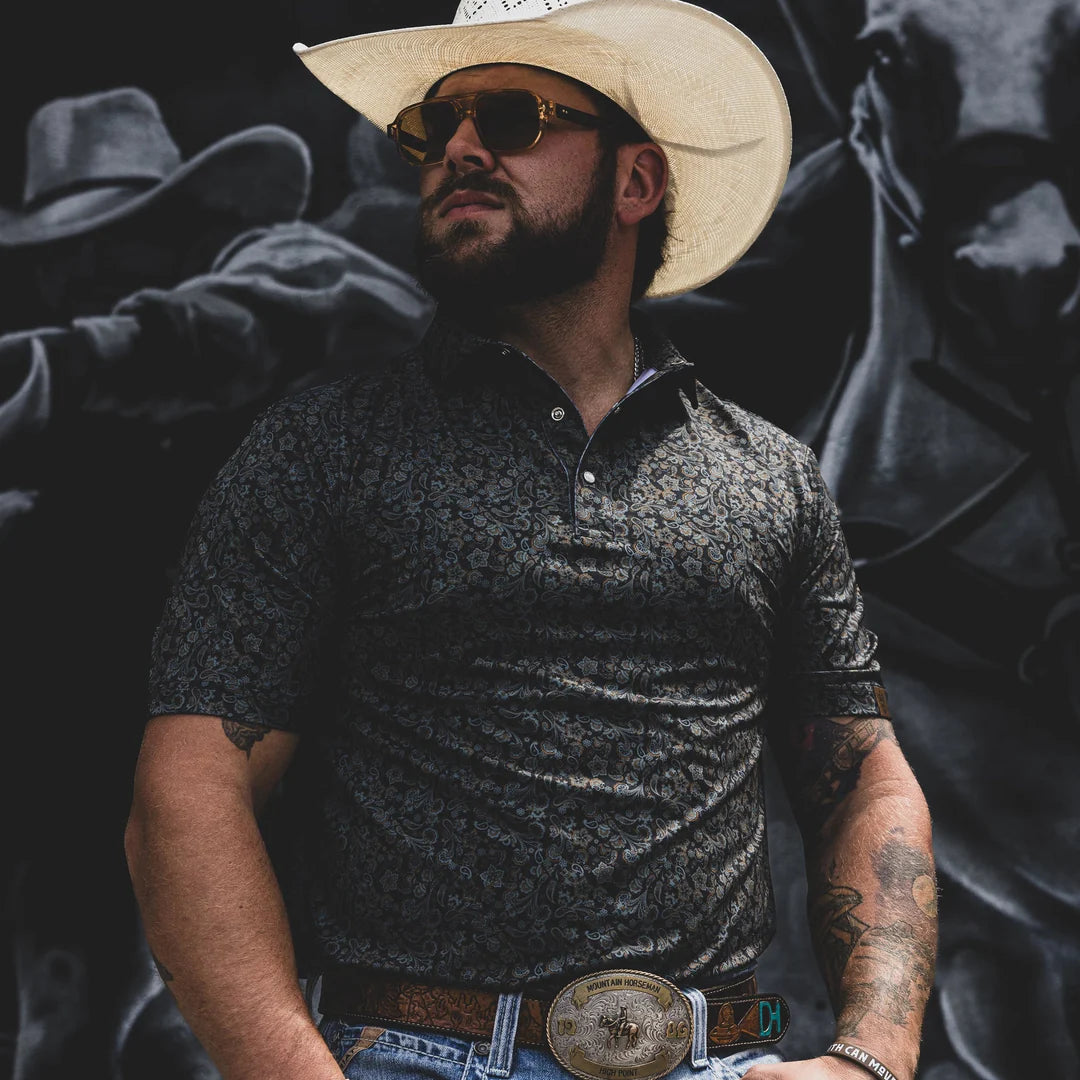
Tough and timeless, this polo is built for the long ride. Featuring a crisp, non-collapsing collar and a rugged, stretchy fabric, it's the perfect shirt for any cowboy's wardrobe.
Author S. Craig Zahler makes his filmmaking debut with Bone Tomahawk, directing from his own original screenplay. And to hear him talk — which we did last month, when his movie had its world premiere at Fantastic Fest in Austin — this is one case where the hyperbolic phrase “Years in the making!” is altogether appropriate. Even with Russell attached to the project, Zahler said, the journey from page to screen was long and frequently frustrating, primarily because potential investors were wary.
“Over the years,” he elaborated, “there were different versions of the movie that might have gotten made. In Mexico, in Utah — each time, I’d go there, scout all the locations and hire up a crew, and then that version collapsed. There was even a version in Romania.
“After it collapsed three times, after ramping up and spending all the time and finding new replacement cast members, new locations — that was difficult. But the most difficult thing, if I had to pick the standout, was the schedule. We wound up shooting this movie in 21 days,” on various locations in California.
Here are some other highlights from our conversation with S. Craig Zahler.
Cowboys & Indians: It's been said that, deep down in his or her heart, every filmmaker really wants to make a western. But I can't say I know of too many filmmakers who have expressed interest in making a movie about cannibalistic troglodytes. Which impulse was stronger for you?
S. Craig Zahler: The urge to make a western. And it's interesting: With the push for this movie when we were trying to get it financed, and certainly through advertising — there’s been a lot of talk and emphasis on the cannibalism and the horror elements. But I don't think it's a horror movie. I think the scenes of horror are strong and deliberate, and they're what I want them to be. When I write [about] crime, the scenes of violence are similarly strong.
But I have written two novels that are westerns. One is Wraiths of the Broken Land, and one is A Congregation of Jackals. And then my first script that set up my career as a screenwriter was The Brigands of Rattleborge. That got me a deal with Warner Bros., and it's one of I think 24 different scripts I've sold to the industry that haven't been made.
And because I just got tired of selling my scripts and not seeing them get made — I started thinking about doing a low-budget horror movie.
C&I: Because nowadays it’s easier to get financing for a horror film than it is for a western. Right?
Zahler: Correct. But here’s the thing: Westerns, as a genre, play more to some of my strengths as a writer, I think. The ceiling on what I can do writing in that genre is higher than what I could do with say, straight horror. It's about the characters. See, I have my strict definition of westerns, which is one of the reasons I'm not a fan of Deadwood. I think almost all of my favorite westerns are physical or moral adventure stories, where the characters face a physical and moral crucible that is the frontier. So if you're just staying in a town and dealing with the dirty politics of the town …
I think Deadwood could have been in England in 1880, and it would have been a pretty similar thing. You would have had to change some of the names, that’s all. But that adventure component, and that idea of people going out into the frontier, and whatever civilization they have inside them they're imposing on other people, or the landscape, or they’re suppressing it — those are the core elements of westerns. I'm a big Max Brand fan, and I go all the way back to Owen Wister and The Virginian, and stuff like that. A lot of the great mythic Westerns.
Q&I: It’s funny: When I tried to describe Bone Tomahawk to someone after seeing it, I said, “Try to imagine if director Budd Boetticher and Randolph Scott had ever made a horror western …”
Zahler: [Laughs] Early on, when we were just talking about the movie, I said, “If I could cast anyone from the history of movies, alive or dead, Randolph Scott is my favorite western actor.” So you've nailed it. Probably The Tall T is my favorite of the ones he did with Boetticher. The guy's terrific.
Q&I: So you wound up writing a horror western. Or, if you prefer, a western with horror elements. Either way, you always envisioned having a limited budget?
Zahler: That’s correct. I knew I could write something that is a “rescue mission” western, and keep in mind some of the budget constraints. I have a background as a cinematographer, so I understand some of the limitations of low-budget filmmaking. That's how it started. And then, 30 days later, I had the script. Maybe a couple months later, we started going out to actors and assembling this cast. But then it was years of different versions that might have gotten made. Kurt Russell was constant throughout this whole thing. Richard Jenkins was there the entire time, except the period where he needed to go off and shoot Olive Kitteredge, in which he's completely fantastic.
But financing always was a problem. There were so many versions of this movie, and so many companies that came and went. They’d say, “We'll do this, but you're going to need to cast so-and-so in this role.” Or, “We'll do this, but you're going to need to cut this down.” For me, there was a certain point where I was dealing with one company — and I won't get specific there, because it's probably not wise for me to. But we got to a point where I said, "If you ask me to cut one more page, I'm going to walk away from the movie." So it got contentious in those situations.
C&I: So what did they want you to cut? Were they squeamish about the horror elements?
Zahler: No, not the horror aspects — the characterization. Which is what attracted the actors in the first place. I'll pick a scene that was targeted by a lot of people: You have Chicory [the deputy played by Richard Jenkins] talking about how to read a book in the bathtub …
C&I: Which is a terrific scene with Russell and Jenkins, developing the relationship between their characters.
Zahler: And your reaction is exactly what I expect. But taking the time to do that — that made some people antsy. This is a two-hour and 10-minute movie, not a 90-minute movie. The 40 extra minutes, I'm taking the time to develop these people. I think that’s one of the reasons in general that the aesthetic of current moviemaking isn't to my taste for the most part. There's this feeling that everything needs to move the plot forward.
Actually, most of the best character moments in movies aren't moving the plot forward. They are just character moments. That scene where Chicory is trying to find out how to read a book in the bathtub, and how it develops the relationship between Chicory and Sheriff Hunt in that scene — yeah, you could cut it out, because it has nothing to do with the story. But it has everything to do with why I made the movie, which is to show these characters going on this journey and facing this crucible that is the frontier.
C&I: Western fans will really appreciate those classic western scenes where you have all four of your male leads riding alongside each other, heading out on their quest together. Either you had some nifty CGI trick photography going on there, or you found actors who really look like they belong on horses. Which was it?
Zahler: [
Source: https://www.cowboysindians.com/2015/10/qa-s-craig-zahler-director-of-bone-tomahawk/