
A cattleman squints beneath the brim of his straw hat at an animal that may soon fetch a price equivalent to that of a Mercedes-Benz Roadster. Fall has come to the R.A. Brown Ranch, and with it a pleasant breeze out of the south. The air is heavy with the vinegary tang of silage feed and the warm, sweet smell of cattle. Donnell Brown passes a pen containing purebred Angus bulls with necks like twin bridge cables connecting broad skulls to muscled shoulders. At the next, he whistles at his finest mamas, dams with briskets the size of basketballs and rib-eyes so finely marbled it’d be a shame to put a knife to them.
Brown knows this for a fact because he personally quality controls the rib-eye of every animal on the ranch with an ultrasound, just like an obstetrician peering into an expectant mother’s belly.
check out our premium collection
The pedigrees here are so carefully cultivated, the matings so thoughtfully curated, that the meat actually isn’t his most valuable asset. These pampered ungulates are vessels for favorable traits, not hamburger on the hoof. The commodity is the semen, the ovum, the DNA, which he keeps on ice in a cylinder filled with liquid nitrogen. Brown is what you’d call a “seedstock” man. He sells to other ranchers seeking to imbue their own herds with rarefied genetics. And he’s got them. Nearly 60 percent of his stock is rated USDA Prime — the crème de la crème — a concentration of top beef that is practically unheard of in the world of animal husbandry.
The Midnight Troubadour
Tough and timeless, this polo is built for the long ride. Featuring a crisp, non-collapsing collar and a rugged, stretchy fabric, it's the perfect shirt for any cowboy's wardrobe.
This, of course, did not happen overnight. And the how of it is both technological and generational in nature.
Beneath the wrought-iron pipe fence separating us from prized bulls that weigh nearly a ton apiece, there are handprints pressed into the concrete, some small and others belonging to men. There are his own, and Rob’s, his father. There are Tucker’s, his oldest boy. The smallest print is Lanham’s, his youngest. “There’s three generations of Browns in that concrete,” he says. If one were to trace the pedigree of the Brown clan like any Red Angus heifer, documentation would put them on Texas rangeland at least as early as 1895. Browns have crisscrossed this prairie, from east of Waco on up to North Texas, on horseback for more than a century hence. That’s five generations now, coming up on six. Even rarer than a 60 percent Prime herd is this kind of longevity in an often capricious and unpredictable business.
Donnell Brown cuts the figure you’d expect of a ranching dynasty’s scion. His eyes are a sharp turquoise. He’s narrow through the hips and broad across the shoulders. He wears a carefully creased, immaculate straw hat, and a scrupulously manicured mustache. His skin is sun-browned apart from the pale forehead strip that his hatband covers. But he isn’t your archetypal taciturn cowboy — he’s more like an articulate, media-savvy CEO, accustomed to doling out well-worn axioms to reporters while explaining his enterprise’s durability over the long decades.
On this late September morning, the man is in fine spirits. His ranch has seen more rain than he can recall in all his 47 years. His Bermuda grass pasture is of such a vivid green that it looks as though it belongs to the Texas coastal plains, not this parched country a little over two hours west-northwest of Fort Worth. And in a couple of short weeks, the annual auction — his most significant yearly payday — commences, which is a local cultural event in itself.
Yes, these are bumper times. But they haven’t always been so.
We climb into his dusty white pickup and head west, then north, and west again along a doglegging caliche road that cuts through his grazing pastures. After less than a mile, Brown pulls off-road into the prairie grass and scrub brush before throwing the truck into park. He slides out and walks to the tip of an outcropping and scans the swell of the ridge lines and the valley’s cradle in between. This is his favorite spot, a place he comes when he needs some quiet. The pasturage hissing against his jeans is a lush carpet of blue grama. Big bluestem grows on the rock-crusted hills. The broken cloud shadows paint the valley blue. It’s easy to see why he loves it here.
He squats and plucks a stem of side oats grama — a bovine delicacy — and eyes the seed heads. Once the weather cools down, he says, the Texas wintergrass will sprout. The earlier settlers didn’t realize it at first, but this can be a cattleman’s paradise. When the ranch gets its sparing 26-or-so inches of annual rainfall, there’s forage nearly year-round. And though there is very little groundwater to speak of, the clay loam holds it well enough at the surface. He has ponds scattered over the short-grass prairie before us like little emerald oases.
“This country has its Sunday clothes on right now,” he says, evident satisfaction in his eyes. “Best it’s ever looked in my lifetime.”


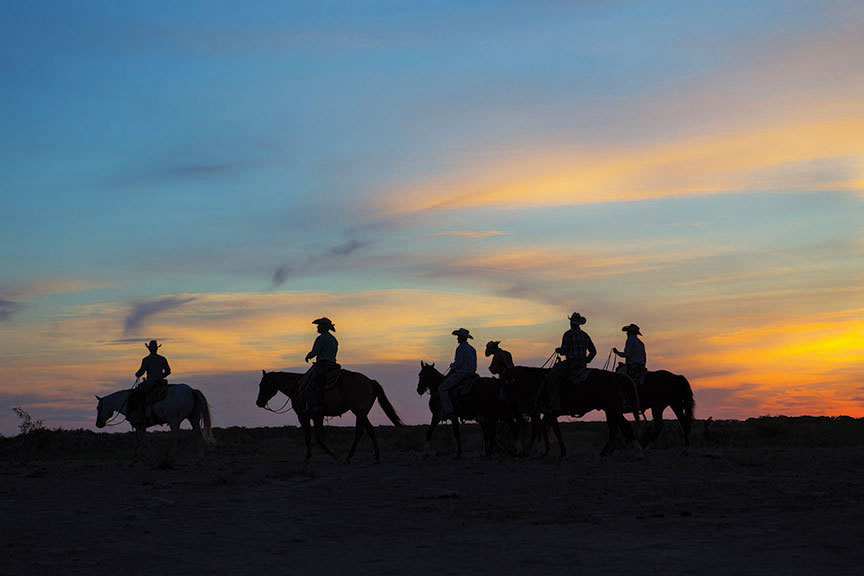

The land isn’t the showy kind of beautiful like mountains or tall forests, but with the right eyes there’s something about its hard luster and the interminable skies above. Every erosive draw, every hill on these 6,500 acres is committed to his memory. But when the rains stop coming and drought sets in, even this comely overlook can become a hard place to love. He saw it in 2011, when 70 percent of the ranch was without water, and he was forced to send his cattle away to Montana, Nebraska, Colorado, any place that was still green, like a father who could no longer provide for his children. He’d seen this country deep in drought twice before that. All the Brown men have endured the dry times. In 1917, the grass died and a brutal winter followed like a one-two punch. The starving cattle froze to death, and 15-year-old R.A., Brown’s grandfather and the ranch’s namesake, skinned and salted the dead ones, and took the hides by wagon nearly 60 miles to Abilene for cottonseed cake to feed the rest. Drought-tolerance is encoded into their genes now.
How do they survive trials that have broken so many other Texas cattlemen? The answers are right in front of us: The oil pump jacks and collection tanks off to the north, which provide a steady income even when cattle don’t. Fishermen and hunters pay him to stalk the ranch’s deer, feral hogs, quail, and, at the moment, doves. He has installed high-tech feed troughs that take the weight of each animal and the amount of silage it consumes each second, and determine which cows and bulls put on mass most efficiently. His adaptable crossbreeds, like the Hotlander, are genetically selected to withstand the withering Texas heat. Someday soon, wind turbines will spike the horizon. They might spoil the view, he says, but you can’t beat the money.
The R.A. Brown Ranch is now what business types might call “diversified.” Each new revenue stream, each technological and genetic advancement, is spurred on by the requisites of survival. Successive generations have dragged an old way of life deeper and deeper into the modern age. “Evolve or perish” could be a motto hung over the front gate.
Yet what’s even more improbable nowadays than the calibrated feed troughs and RFID ear tags is the simple fact that five generations stayed here and didn’t run off to Dallas or Austin.
When Brown was a young man, his father gave him two cows and told him that if he planned to leave the ranch, to stay gone for at least two years. If he wanted to return after that, he explained, it would either be as an entry-level hand or as a partner with a business plan and a cash-flow statement. If he intended to come back, his father said, “we’ve got to make the pie bigger.” So Brown went off to Texas Tech University and studied animal breeding and genetics. He took a couple of years off to become the national president of Future Farmers of America and moved to Alexandria, Virginia, to press the FFA’s cause in Washington, D.C. For a time, he thought he’d leave ranching for good and begin a career as the Cattle Baron of the Beltway, lobbying Congress on behalf of men like his father. As the youngest
Source: https://www.cowboysindians.com/2017/04/the-modern-empire-of-the-saddle/