
Born February 6, 1911, in Tampico, Illinois, Ronald Reagan would grow up to become the 40th president of the United States. It’s been years since he left office on January 20, 1989, and since his death on June 5, 2004.
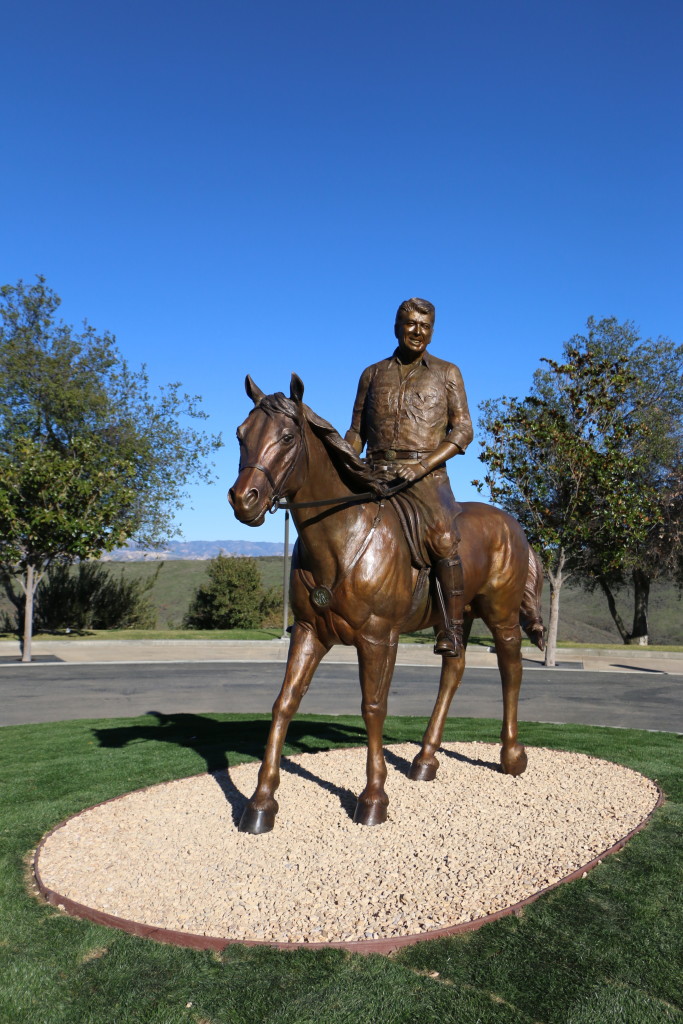
Gone but not forgotten, Reagan is perhaps most alive in his legacy at the Ronald Reagan Presidential Library in Simi Valley, California, located at 40 Presidential Drive (naturally) in the horseback country he loved so much. Now, Reagan rides again with the library’s unveiling of a new equestrian sculpture called Along the Trail on what would have been the president’s 105th birthday, February 6, 2016.
check out our premium collection
Along the Trail depicts the late president astride his favorite horse, El Alamein. Standing more than 11 feet high and weighing more than 2,500 pounds, it took close to 10,000 hours to complete. For American sculptor Donald L. Reed, the heroic piece is a magnum opus in a fine art career that spans more than 50 years and demonstrates an exceptional ability to capture movement, likeness, and character in sculpture and metalwork.
The Midnight Troubadour
Tough and timeless, this polo is built for the long ride. Featuring a crisp, non-collapsing collar and a rugged, stretchy fabric, it's the perfect shirt for any cowboy's wardrobe.
C&I talked with Reed and the Reagan Library’s Joanne Drake about the new Reagan work of art.
Cowboys & Indians: Tell us about the exciting new sculpture.
Donald Reed: The Reagan Foundation commissioned me to create a portrait of President Reagan astride his favorite horse, El Alamein. The piece, which is entitled Along the Trail, is one-third of what I refer to as the Trail series. Begins the Trail is a life-size sculpture already installed in the president’s hometown in Illinois. It marks his early years and his enthusiasm for horseback riding. Along the Trail is the second piece in the series, and it captures the moment of President Reagan in his later years riding while living in California. He’s older and probably retired, just riding and enjoying himself. He rode as long as he was alive and able. The third piece in the series has not been named, but it should be a piece for Washington, D.C., commemorating his years as president, also with him on horseback.
C&I: Why did you decide to portray Reagan horseback? Did you work from a photo?
Reed: The real answer is that someone, years ago, asked me to do a proposal for a life-size portrait of President Reagan. I decided, instead, to create the threefold Trail series concept and portrayed the president in his youth on horseback. It always seemed that the president appeared happiest while riding horses. I assumed that he found great solace while riding, as well as a connection with the world around him. I am betting that he did his best thinking while riding.
I reviewed what I believe to be the entire photographic library available on the president, as well as his films and television series (Death Valley Days, etc.). I selected, perhaps, a hundred photos of the president and El Alamein to work from.
C&I: What attributes of Reagan were you hoping to portray? What emotions were you hoping to convey/elicit?
Reed: Simply his good nature, his outgoing personality, and exuberance while riding. His style, the way the horse and rider are saddled and attired — that’s all authentic. Hopefully, the viewer will sense or see the spirit of America, the West, and be inspired.
C&I: Tell us more about the horse, El Alamein, whose name, I imagine, comes from the town in northern Egypt on the Mediterranean where British forces under Bernard Montgomery won a decisive battle against Erwin Rommel’s German troops in November 1942.
Reed: El Alamein was a gift to President Reagan from the president of Mexico, José López Portillo. He is a Spanish Arabian stallion. President Reagan kept him as a personal gift because he was not in any official office when the gift was made. I believe El Alamein, who was not particularly friendly to any other riders apart from the president, became his favorite because of the challenge he presented. President Reagan rode with the style of a military rider, which he learned in the U.S. Cavalry as a young man. As a result, most photos show clearly that he held a very tight rein on any horse that he rode.
El Alamein was a tough horse. I only recently found the answer to a question that I have been thinking about for the past several years: What ever happened to El Alamein? My friend, Johnny Z., sent me a note confirming that he was finally buried on Boot Hill at the Reagan ranch, along with many of the Reagan family’s pets. Whereas I attempted to do a journeyman job of sculpting the president, I thoroughly enjoyed the challenge of sculpting his white horse. I believe that it is an acceptable and exceptional rendition.
C&I: What was the hardest thing to get right on Reagan? On El Alamein?
Reed: Such an easy question — to keep from having his portrait appear to be a caricature of what we all imagine him to have looked like. It seems that everyone knows the smile and his hair, but it was a huge challenge to make him appear as his good-natured self without over-accentuating some of the features. President Reagan’s face is at once easy to portray but, in reality, is incredibly complex. I believe the proof of whether his portrait is successful or not will be answered by the American public who knew him so well.
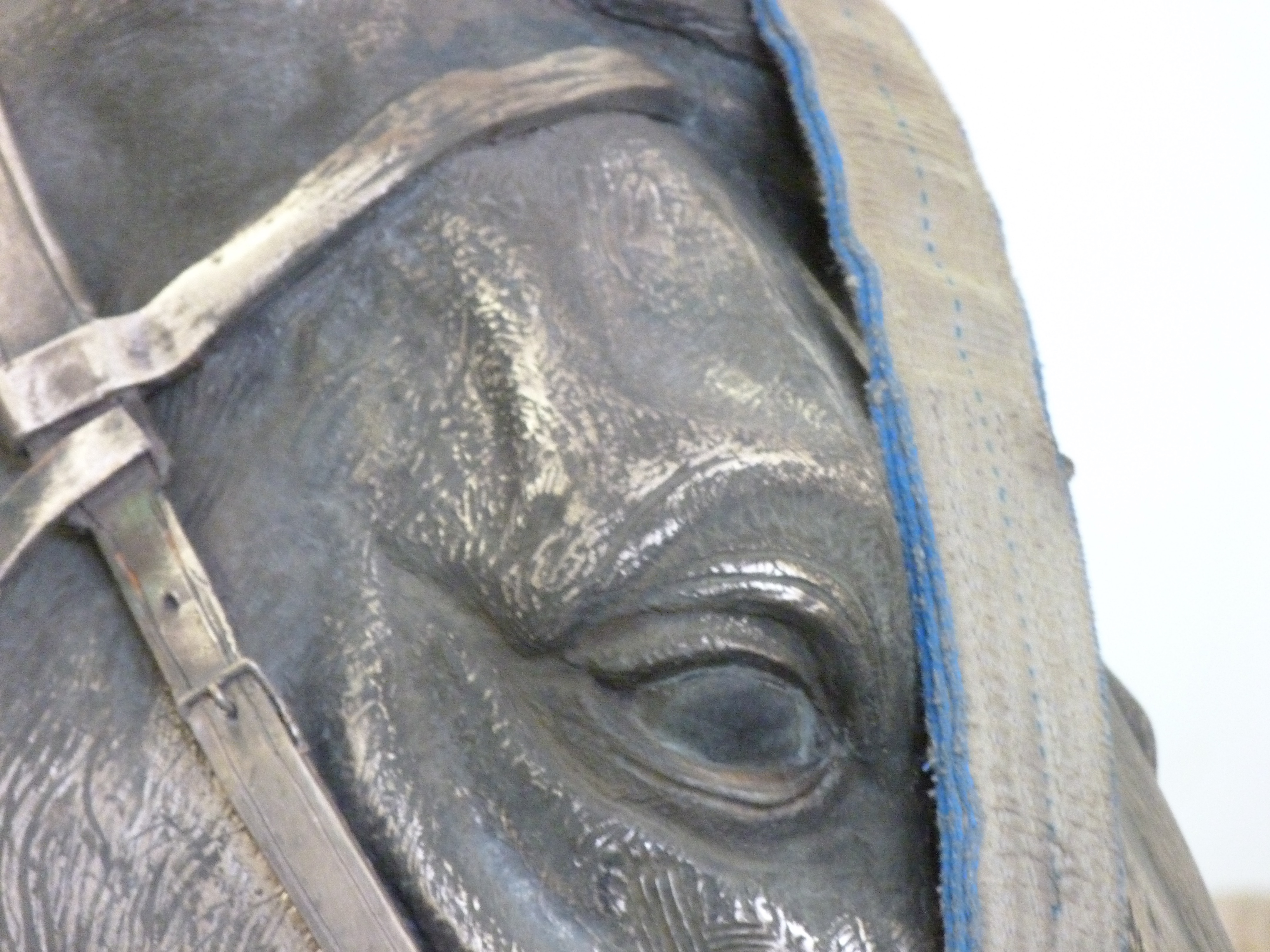
El Alamein was no less of a challenge. Any artist can do a portrait of a horse, but the challenge is to make it look like the horse they are attempting to portray. I took as little artistic license in fashioning the president and El Alamein as possible.
C&I: With all that went into it, it must have been a nerve-racking adventure getting the finished sculpture installed. …
Reed: Actually, I was rather calm. It was my family who were far more concerned, mostly on my behalf. I’ve been in a foundry setting for over 40 years — not much phases me.
We began preparations for packing and shipping mid-January and loaded the sculpture on a snowy day in southern Wisconsin. The statue went inside of a crate that took two and a half days to engineer and build for its trip across the country.
It was shipped by tractor trailer and was driven by two gentlemen —both proud military veterans. They knew they were carrying a cargo worth $1.75 million — that was the insurance value of the shipment. They were careful, needless to say. I was told that there were maybe two small potholes along the way and the rest of the ride was smooth. It’s just been perfect — like someone was watching over everything. It was two days’ worth of continuous driving. They never pulled over, except for necessities.
Once in Simi Valley, we began the process of unpacking. There was so much wind, probably 40 to 60 miles an hour at times up on the hill, 30 to 40 continuously. We were concerned about the sides of the box collapsing on the piece. The biggest challenge was picking up the casting out of the box and moving it to the actual installation site about 60 feet away. We are talking about 1.5 tons of bronze and stainless steel. The horse and rider are cast out of bronze and the armature is made of stainless. The armature runs all the way through the piece, down through the legs into the footings, which are anchored underground and are secured by tons of sand and concrete. There’s no sub-base — it looks just like the horse and rider are walking across the field.
During the installation process, I slept about 20 hours, maybe 15, from Sunday to Thursday waiting on the elements. In the end, it was approximately no more than a micro-fraction of an inch off of what I anticipated from shop to locati
Source: https://www.cowboysindians.com/2016/02/ronald-reagan-rides-again/