
If the work of a master Western landscape painter is never really done, Russell Chatham has probably gotten closer than anyone. The self-taught artist and inveterate outdoorsman — tapped by Field & Stream as the country’s greatest living landscape painter — has delved into the wild Western canvas with a lifelong passion and tireless sense of purpose and play that can be called legendary without a brushstroke of hyperbole.
“I’ve been painting ever since I was little — and as soon as I was able to drive and got an old beater car, I was a fisherman and a hunter as well,” says the 78-year-old artist and accomplished writer and angler, whose earliest exhibitions in the 1950s drew on the small ranching communities of Northern California’s Marin and Monterey counties where he grew up. Eventually, Chatham would take on the goliath of Western imagery — Montana — where, over a three-decade tenure, his oil paintings and exhaustively detailed lithographs would find fame and sky-high demand among the country’s top art collectors and other big names.
check out our premium collection
“I really didn’t go there thinking that if I hang out in Montana I’ll be a successful artist. I just pretty much assumed I would never be one in that way,” says Chatham, who isn’t averse to spending a year or more on a painting to get it exactly right in spite of short gallery supplies of his work and long client waiting lists. “That’s not what all of this was ever about anyway. I just wanted to do it — plain and simple.”
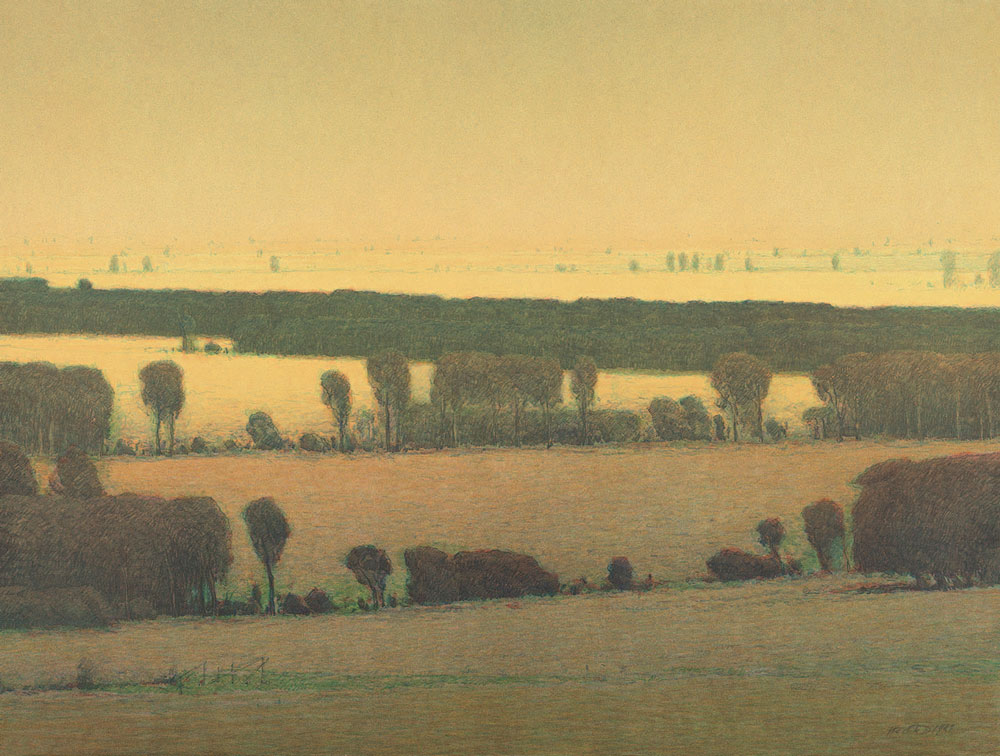
Chatham is also naturally complex. His laborious lithographic process has utilized as many as 50 plates and ink shades (standard lithography often sticks to three or four). Although the effect of his art is anything but laborious. Gazing into the paradox of a Chatham oil painting — dreamy and real, rich and spare, warm and shivery, quiet yet intense, joyful yet sometimes foreboding — is less a visual exercise than an absorbing one. These are transportive, experiential images. A cluster of aspens glowing by a hulking hill. A linear horizon of wilderness meeting a shapeless, spectral sweep of approaching rain. A pair of cumulous cloud shapes, grazing like faintly recognizable farm animals in the sky above the oblivious flats of vast hayfields below. All are simply titled scenes: Aspens, Sweeping Rain, Hayfields. And all are unmistakably Russell Chatham, as profoundly felt as they are seen.
Having recently returned to the Northern California landscapes where he first held a brush, Chatham spoke to us from his studio tucked on the edge of Point Reyes National Seashore — casually fielding too many different topics for one person: finding color in a Montana snowfield, taking lithography to another level, bird hunting with good friend and late author Jim Harrison, favorite fishing spots. These are all part of the Russell Chatham palette. Happily, so is the artist’s latest round of deep inspiration way out West.
The Midnight Troubadour
Tough and timeless, this polo is built for the long ride. Featuring a crisp, non-collapsing collar and a rugged, stretchy fabric, it's the perfect shirt for any cowboy's wardrobe.
Cowboys & Indians: Much of your work has been tied to the rugged landscapes of south central Montana before your return to Northern California’s Marin County, where you grew up and began painting. From a landscape artist’s perspective, could these two Wests be any more different?
Russell Chatham: They probably couldn’t be much more different from anyone’s perspective. Although I’d say that they do share certain intrinsically Western qualities, which would be the solitude, wildness, beauty, and utter timelessness you can still find in both places — I mean, depending on where exactly you’re standing.
C&I: Where exactly are you standing?
Chatham: Right now I’m in my painting studio in Inverness Park, California. I live about 15 miles up the road in Marshall, population 50, but you’d have to turn over a lot of rocks to come up with those 50 people. The ranch I live on is thousands and thousands of wilderness acres, and there probably aren’t 25 people residing on it. And my drive to work along the edge of Tomales Bay is pretty much the commute from heaven. On a weekday morning, I usually don’t pass a single car.
Marin County, of course, has those other connotations nowadays — like being super-uptight, posh, and crazy-expensive. But where I’m based, it’s real wilderness. Just one big ranch on top of the next, run by a handful of old ranching families who still hunt deer. So you could say it has that in common with Montana. It’s still out there.
C&I: Was this a formative landscape for you as a young artist? The timeless terrain of the other Marin?
Chatham: Absolutely. As well as the Carmel Valley down in Monterey County where a lot of Swiss-Italian immigrant families, including my mother’s family, bought land in the 1850s for practically nothing. I spent a lot of summers down there as a kid with my brother and two sisters, and it was about as simple and remote as it gets. No TV, no electricity, no nothing. We had a choice: Go play in the creek or go paint.
C&I: Or go paint the creek.
Chatham: [Laughs.] I often opted for both.
C&I: Was your famous grandfather [landscape painter Gottardo Piazzoni] an influence in your early painting pursuits?
Chatham: He was a very great painter, but I was only 5 when he died, so my actual time with him was limited to early memories — though I did get to see him paint. I remember my mother taking me to his studio in downtown San Francisco and watching him up on the scaffolds working on some new murals for the San Francisco Library.
After he was gone, his paintings were all over the house, so in a sense he was still there, and his work was certainly an influence for me — especially once I was old enough to travel to New York and Europe to see the great art of the Western world. It made my grandfather’s paintings even more meaningful because I realized that they could hold up against all of that.
C&I: Ironic that you had to go east to fully appreciate great paintings of the West.
Chatham: Well, you know, the West was a fairly primitive place from an artist’s standpoint back then, if you want to know the truth. I mean, the only real center for it was San Francisco, along with some artistic activity happening in the L.A. area. When I was a younger artist, this whole area was still a frontier that way. I remember being told that if I wanted to be an artist, I’d need to move to New York. And I said, “Well, then I guess I’m not gonna be an artist, because I’m not moving to New York.”
C&I: You became an artist and moved to Montana instead. An unconventional decision with its own rationale?
Chatham: A very practical decision in its own way. It was 1971; I was 31 years old; I saw the crowds coming to California, and things starting to get very expensive where I was. And, I thought, I can’t hold down two $1.50-an-hour jobs in Marin and try to paint on Saturday. That’s just not going to work. I’m never going to learn.
Fortuitously, my friend [writer] Thomas McGuane had gone to Montana, called me up, and said, “C’mon and go fishing with me and hang out.” I went there and just immediately thought, This is it. All the space, beauty, wide-open landscape, and hunting and fishing I could ever want. Here was this place called Livingston, Montana, where I could rent an entire 600-acre ranch back then for $500 a year. So that worked.
C&I: Montana is a giant canvas for a young, self-taught landscape painter. Was it a challenging transition? Source: https://www.cowboysindians.com/2017/12/russell-chathams-window-to-the-west/
Chatham: When I first went to Montana I was baffled. I remember thinking, I really don’t know if I can paint this at all. I knew I had to, but it took years to figure out an approach to its sheer size and physicality — and also to what I could paint out there that made sense to me and felt real. I mean, it wasn’t going to be the Old Man