

Like a lot of people who weren’t lucky enough to be born there, Franklin D. Speyers’ first connection to the West came from watching westerns when he was young. It wasn’t till he was grown with kids of his own that he actually ventured into the West on a series of family vacations. The initial foray, in 1993, went for the iconic: Speyers and his wife and their two boys drove to the Grand Canyon. It would be their first encounter with Native Americans — a future subject for a not-yet-contemplated art exhibition almost 25 years in the offing.
“After staying overnight at the Grand Canyon, we headed north to Tuba City [Arizona]. On the side of the road we saw these wooden booths set up by Navajos selling their jewelry,” Speyers recalls. “Joshua and Jonathan looked over the goods, and Josh suddenly ran back to me and said, ‘Dad, you need to buy something from that Indian man because he is really kind.’ I did, with my heart in my throat, for Josh was right: This man was truly so gentle and kind that I found it impossible not to buy from him.” Just west of Tuba City, they met a Navajo man pouring water on petrified red rock to reveal what he explained were dinosaur tracks. “Again, the same experience: A gentle aura of kindness surrounded this Native American.” In 1995, the West-enamored Dutchman took his family on another vacation in the West, this time a five-day rafting trip down the Colorado River from Moab, Utah, to Lake Powell.
check out our premium collection
The memorable adventures, landscapes, and people — from the genial Native Americans they met along the road to the pot-smoking raft pilot with whom they charted the Colorado — stuck with him. The trips are documented in fading color photographs. It would be more than 20 years before Speyers headed back with the idea of painting what he saw and experienced. It turned out to be far beyond compass points, GPS coordinates, and preconceptions.
The Midnight Troubadour
Tough and timeless, this polo is built for the long ride. Featuring a crisp, non-collapsing collar and a rugged, stretchy fabric, it's the perfect shirt for any cowboy's wardrobe.
On four different occasions, Speyers participated in Shearers’ Artist Ride in South Dakota, taking wife Bonnie on his first two trips and now-grown sons Josh and Jon on his last time out. An annual event that’s been attracting artists from all over since 1984, the Artist Ride transforms the Shearer ranch near Wall, South Dakota, into living history scenes of cowboys, Indians, horses, and cattle — all ripe for the painter’s brush.
Speyers would find himself shooting thousands of photos for future reference, enjoying the camaraderie of real Westerners, and even helping to extricate his filmmaker son from a certain very modern situation: “Jonathan had gotten permission to shoot the Artist Ride with his drone, but the cows thought it was an angry swarm of bees and wouldn’t leave the Cheyenne River.”
The greater challenge wouldn’t present itself till after Speyers returned to Michigan to begin work on the more than 30 paintings he intended for his upcoming West of the Imagination exhibition. He had no idea just how much he’d have to cowboy up to complete them all. “Last December, I was diagnosed with cancer, and I was operated on January 30, 2017,” Speyers says. “I’m in remission now, but I feel a new sense of urgency to get these works done — though I am counting on my rehab coach to help me create the strength I need to paint at least six hours each day.”
Speyers took time out from rehab and painting to talk with C&I about life in the art lane and how his Dutch roots and Western affinities have mapped his journey.
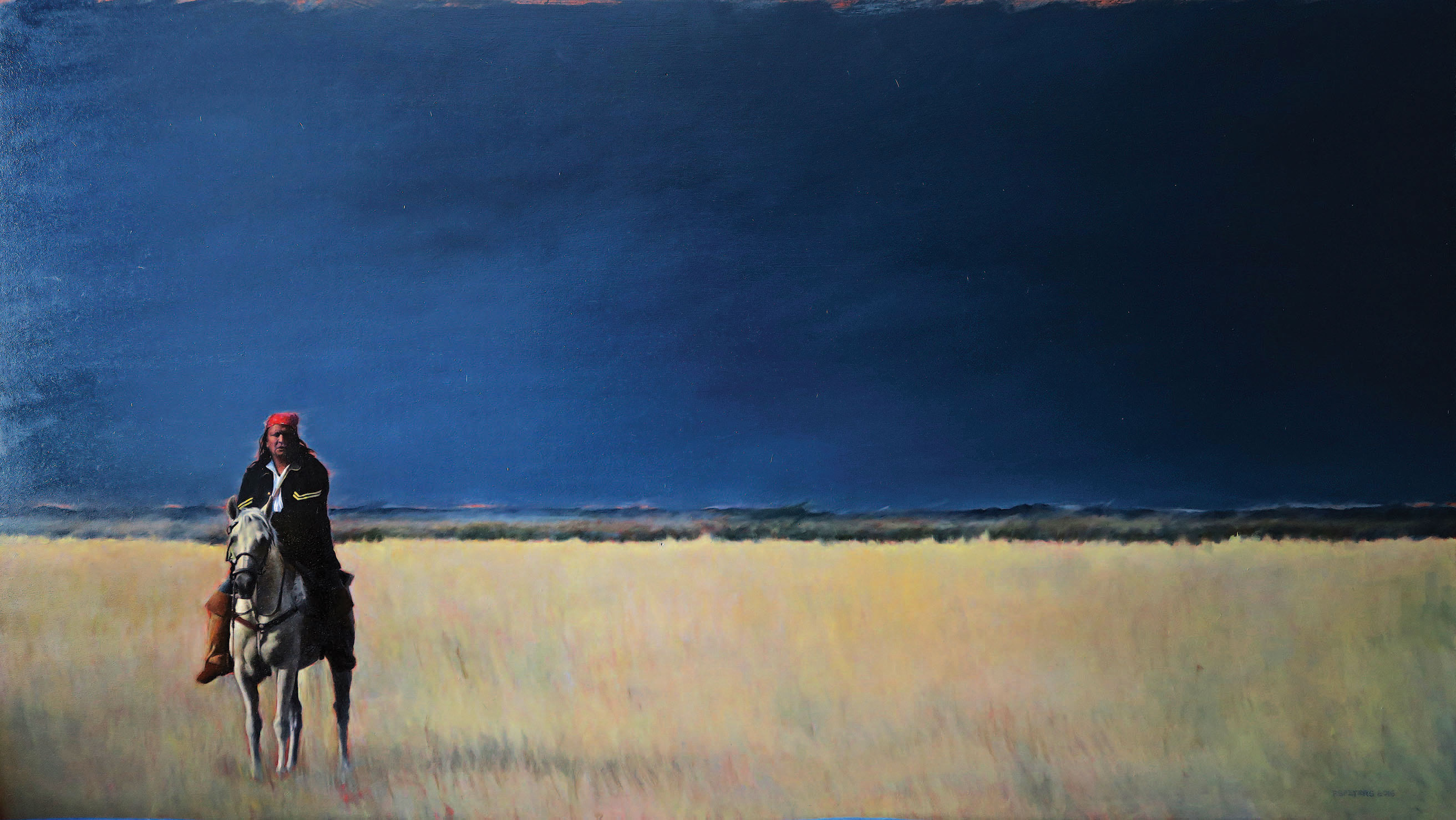
Cowboys & Indians: How is it that a Dutch immigrant, one-time Canadian, and eventual American citizen came to love the West?
Franklin D. Speyers: Probably like many in my generation, I largely came to “the West” through movies. We were exposed to black-and-white television glimpses of a rugged, heroic people in a dry, hostile landscape. I recall in 1956 watching Gene Autry on our neighbors’ black-and-white TV in Chatham, Ontario, Canada. I was totally captivated by everything about the West. My family had immigrated to Canada from the Netherlands only a few weeks earlier and could not afford a TV. But the neighbors had one, and that’s all it took. I couldn’t understand a word of English, but as a stranger in a strange land I was drawn into an enigmatic kinship with a genre that dramatized the triumph of the self-reliant lone hero overcoming conflict.
Send a city boy like me out West and his heart almost explodes with joy as he tries to get his head around the gargantuan scale of it all. The raw, unabashed rush of breaking a bronc or branding a calf. The delightful mix of aw-shucks humor and serious banter. The vivid contrast between the honest freedom of the West and the textual tiptoeing done in academic bubbles is startling. I’m a wannabe Westerner — it’s true; yet when I’m in the West, I see more clearly. I think more simply. I’m energized. I’m refreshed. I’m me.
C&I: You’re an academic: a master’s in communication design from Pratt Institute in New York, postgraduate studies at Harvard’s Graduate School of Design, and, since 1988, a professor of “design as language” at Calvin College in Grand Rapids, Michigan. You’re also a husband and father. With all the demands of teaching and family, how did you fit in fine art and what inspired you to stick with it?
Speyers: In all honesty, there were many times that I gave up on it altogether. But there were those summer months when I allowed myself to breathe again and reach backward to a phenomenal approach of art-making. I started with gouache landscapes and stayed with that familiar motif for two decades. It wasn’t until 2006 that I became courageous enough to seriously pursue plein-air painting. I drove out to Monument Valley in Arizona and figured I’d paint till I got the hang of it. I recall musing with my Navajo guides about the distant rain that fell but evaporated before it hit the valley floor. It didn’t take long for the dust and sand in those annual summer monsoons to sweep through the valley and disable my contact lenses.
C&I: In spite of the dust under your contacts, were you hooked on plein-air?
Speyers: Indeed. I flew out to California in 2007 and 2008 to learn how to apply oil paint with speed and accuracy from Greg LaRock in Laguna Beach, Randy Sexton in San Francisco, Tim Horn in Marin County, and Maggie Hellman in Santa Cruz [California]. In 2008, Eric and Barb Winkelman sponsored me as artist-in-residence in the Glen Arbor Art Association. The National Park Service in Sleeping Bear Dunes National [Lakeshore[ took notice of plein-air paintings that I did during the winter months, which led to a poster and subsequently several plein-air workshops I taught in Omena, Michigan. It was awesome to capture the stunning beauty of that scenic M-22 along the Lake Michigan shoreline of the magnificent Leelanau Peninsula, yet my heart tugged at me whenever I flew over the parched landscape of the Southwest when my wife and I visited our son Jon at USC, where he was pursuing a master’s of cinematography.
C&I: You were also eventually drawn to another part of the West: South Dakota. How did you learn about Shearers’ Artist Ride on the Shearer family ranch near Wall?
Speyers: I believe I learned about it through an article in Smithsonian magazine. The first time out on the 60,000-acre Shearer Ranch in 2011 was pretty impressive. There must have been 50 Lakota, Comanche, Apache, Cheyenne, and Navajo tribesmen represented with another 50 or so cowboys. That initial trip left an indelible impression on my imagination. Jim Hatzell, the [now former] organizer, worked closely with cowboys and Indians in the staging and reenactment of how these two cultures clashed and
Source: https://www.cowboysindians.com/2017/08/franklin-d-speyers-west-of-the-imagination/